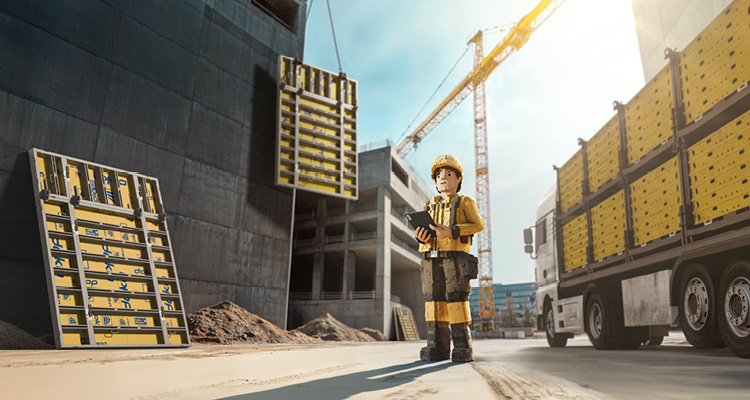
With the world’s largest self-climbing core system underway, Doka USA proves heritage and innovation can coexist

At 40 feet wide, one of the world’s largest self-climbing core systems rises above Lower Manhattan, climbing skyward wall by wall and self-supporting as it goes – at present, a scale rarely seen in self-climbing construction. “There’s only a handful of companies globally that have the engineering know-how and the equipment availability to pull off this kind of construction,” says Michael Kennedy, CEO of Doka USA – the formwork and scaffolding company behind the pioneering project. It is, by Michael’s own estimate, likely the largest core project ever built in North America.
“We were fortunate to have already validated and refined the shear wall climber SCP through several earlier large-scale applications across different markets,” he reveals. “Those experiences helped us strengthen the system, refine our approach, and prove its performance in demanding real world conditions. We have now delivered multiple projects with this new system, with the current Lower Manhattan project being the ultimate.”
Doka – a company that has spent over 150 years building the tools for architects and contractors alike – has long carried a reputation for precision engineering at scale. As Michael puts it, the company “produces best-in-class quality products, backed by strong engineering and people with deep market knowledge. That’s carried through into how we approach digital tools.”

Digitally driven
As 2025 presented numerous challenges across the US and North American construction markets, namely inflation, delayed projects and broader economic uncertainty, Michael notes the effect this had on Doka. “We still made progress, but the market just wasn’t as robust as we’d have hoped – it certainly didn’t help.” In Canada, cross-border trade tensions added further hesitation for developers deliberating over new projects. However, the climate has shifted, and, according to Michael, US business is now well above 2023 levels. He remains optimistic about momentum building across the Americas and nowhere is that ambition clearer than in Doka’s digital push.
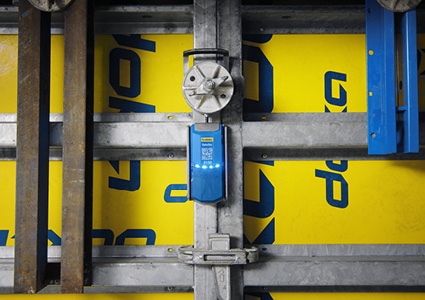
The business has very recently rolled out Doka 360 in the US – a platform almost a year in development, now officially launched following phased pilot testing selected markets across the southern states. The tool addresses a problem every contractor recognizes: the mayhem of tracking materials, equipment and scheduling across a live construction site. “It’s always chaotic,” Michael says of commercial concrete work, as he highlights the precision Doka 360 brings to specific tasks – even down to knowing when to strip forms from curing concrete. “During the proof-of-concept phase, we worked closely with test customers, gathering their feedback and using it to continuously improve the platform,” Michael explains. The platform’s reach goes beyond convenience. Doka 360 can bring real-time insights from Doka’s smart sensor solutions directly into the platform. Concremote monitors concrete temperature and strength development, helping teams determine when stripping can safely begin, while DokaXact provides real-time information on factors such as fresh-concrete pressure, formwork loads and, depending on the application, formwork positioning. The result is a level of remote visibility and control that wasn’t possible only a few years ago. Ultimately, it enables teams to access information directly that once required a phone call to an account manager.
The same instinct for solving practical, on-the-ground problems is also driving Doka’s intelligent heated formwork. Rather than heating an entire enclosed job site – the plastic-sheeted, heater-filled setups familiar on winter builds – the technology targets heat directly at the concrete and formwork itself. Although still in the prototype and field-testing stage, the concept has significant potential, particularly for cold-weather construction and the growing use of CO₂-reduced concrete. “It’s more prevalent in cold-weather situations,” explains Michael. “Whether it’s hot or cold, temperature has a major impact on concrete setting and strength development, which directly affects planning and cycle times. We’re trialing it with people who are willing to try something different from the heating blankets and enclosed spaces that have traditionally been the industry norm. It’s innovative, and it could solve real issues around safety, productivity, and energy costs.”
Credibility and capability
Geographically, Doka’s remit now stretches across Canada and Latin America alongside the US – markets Michael labels as increasingly shaped by ageing infrastructure. Water systems, wastewater networks, dams and bridges across the Americas are reaching the end of their working life, driving what he sees as some of the region’s most significant upcoming projects. “Labor is a challenge everywhere, as people continue to age out of the construction industry,” Michael acknowledges. “Although I think there’s more emphasis now on people building careers in the trades, so we’re optimistic about a new generation coming through. What we’re seeing across the US is an increased emphasis on civil and infrastructure projects, alongside evolving transportation needs in every state, and it’s in this sector that we see the biggest and most influential projects developing.”
All of this underpins a clear strategic goal for Doka: to move from being one of the top players in every market it serves to the outright leader; an achievement Michael hopes to reach within the next three to five years. Tying the company’s engineering feats to its digital ambitions is a fundamental notion that Michael keeps returning to throughout: quality without compromise, supported by transparent delivery schedules and smarter ways of working. “We want to be a true partner for our customers,” he ends, “Not just suppliers.” As Doka 360 rolls out beyond its US pilot regions and the shear wall climber system completes its largest project yet, that balance of historic engineering credibility matched with innovative new capability looks set to define Doka’s next phase of growth.