Why Tarlton and Son’s Frame-2-Finish model is integral for winning contracts and building success stories
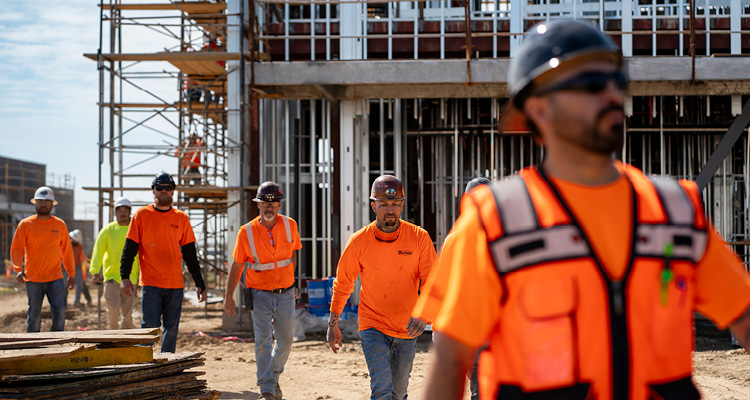
At 111,000 square feet, seven stories and 420 beds, Cal Poly student housing on the Central Coast is such an impressive project that state officials – including California’s CFO – are visiting the site as a potential model for future University Campus builds. It is one of the tallest modular buildings to be completed in California; truly innovative and modern construction, delivered by Fresno-based company Tarlton and Son Inc (Tarlton), along with Whiting-Turner. “It’s incredibly exciting to be part of this build,” opens Blaine Steele, who joined Tarlton in 1998 and has been the Company President since 2013. “It creates a huge success story – both for the Campus, and for us being the first ones to do this.”
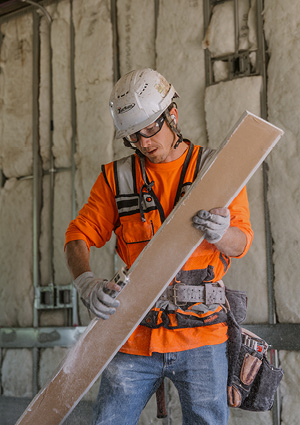
Started in 1977 by Tom Tarlton, the firm initially provided lath and plaster work in the Central Valley, building up a lath-and-plaster and scaffolding business over about 20 years before opening an office in Arroyo Grande, California in 2005. “Tom’s son, Tommy, was working out in the field but he’d started to take on much more – the bidding running of the company – after Tom was injured in an auto accident,” explains Blaine. “Tommy asked if I could come and help him build the company, so today Tommy is Owner and I am President continuing the vision Tom Sr. started in 1977.” Tarlton has since grown through a series of acquisitions and expansions, including a small paint company in 2014, and a door and hardware company in 2018, demonstrating its deliberate Frame-2-Finish operation. “Over the last 18 years, our focus has evolved into ‘building opportunities for success stories,” he continues. “For our team, for our clients, and for our community. The Frame-2-Finish model is a vehicle for that deep purpose.”
Creating efficiencies
Tarlton’s Frame-2-Finish model reduces the coordination burden on general contractors (GCs), who may otherwise have to manage and sequence many separate trades. “Coordinating multiple trades is always a big problem for GCs,” Blaine states. “Consolidating trades under one contract creates efficiencies. A single project manager can oversee multiple trades and understand the sequencing, and the GC no longer has to manually hand off between trades.” Framing typically drives a project’s overall schedule, so Tarlton’s involvement across the full sequence allows the group to anticipate downstream issues before they occur. “We can see where the problem’s going to arise, and we don’t wait for the GC to give us an answer – we’ll bring it up to them, with a solution,” reveals Blaine.
The door division is a shining example: previously, door frames could be delivered with the wrong specifications, and the error wouldn’t surface until installation – a mistake which could end up costing weeks of delay in finding replacements. However, as Tarlton’s door division works alongside its framing division, changes are caught and corrected prior to installation. “Sequencing it all under one roof creates a massive saving on impacted schedules,” Blaine highlights, describing the old, fragmented model as “death by a thousand cuts” to a job schedule. “Superintendents consistently respond well to our Frame-2 Finish model, telling us how much they love it and requesting continued work from us. It’s fantastic.”
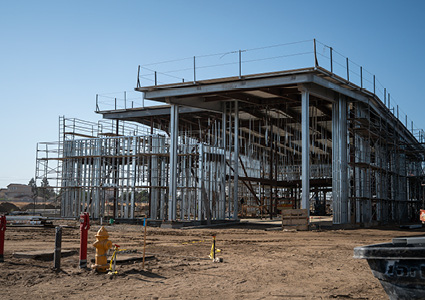
Another illustration of the popular model is the King Hussein school project in Madera, which Tarlton won as a bid-build job alongside Harris Construction, where the group delivered framing, drywall, taping, painting, doors and hardware – effectively the full Frame-2-Finish program. The project was a 124,000-square-foot, nine-building school, built from scratch on donated farmland, with the buildings framed in around four months. “It was a huge undertaking, and we executed successfully,” says Blaine. Although a few external trade-related delays happened outside the company’s control, he credits the operations team with keeping Tarlton’s portion of the schedule on track and the school was recently occupied, with some punch-list items still in progress.
Impressive project portfolio
Blaine also reflects on Tarlton’s people-first philosophy. While technology and AI improve efficiency, he emphasizes the persistent value of direct communication and the importance of the company’s core values: GSD, LFG, humility and respect. “Our values underpin how the team operates,” he notes. “We’re not just putting screws in the wall – we’re building people. We’re trying to help them achieve their own success story.” The company’s role, he elaborates, is to provide the tools and opportunity – but fulfilling that opportunity is ultimately up to the individual.
Employing around 260 people across the state, communication and transparency remain ongoing priorities for Tarlton, supported by digital tools including Microsoft platforms and AI. What’s more, it recently completed the Reedley Performing Arts Center – a complex, acoustically focused building for a small Central California community. “We really pride ourselves in those types of builds,” adds Blaine. “Some builders might shy away from such projects due to their complexity, but we see them as a challenge that we love taking on.” Upcoming projects include the VAPA Building for Central Unified School District, the Kavli Institute for Theoretical Physics at UC Santa Barbara, courthouse exterior remediation projects in Los Angeles and preparation work ahead of the 2028 Los Angeles Olympics.
With an exciting array of projects already in the pipeline, Blaine expects continued investment in their people through learning and development coupled with technology over the next five years, along with a shift toward more design-build work. “We don’t have in-house architects at Tarlton but we work closely with our client’s design teams, and I think architects are going to seek input earlier in the design process, rather than delivering complete plans for bid,” he predicts. “Lastly, we’re aiming to have a greater presence in Northern California and keep growing our Frame-2-Finish offering.”