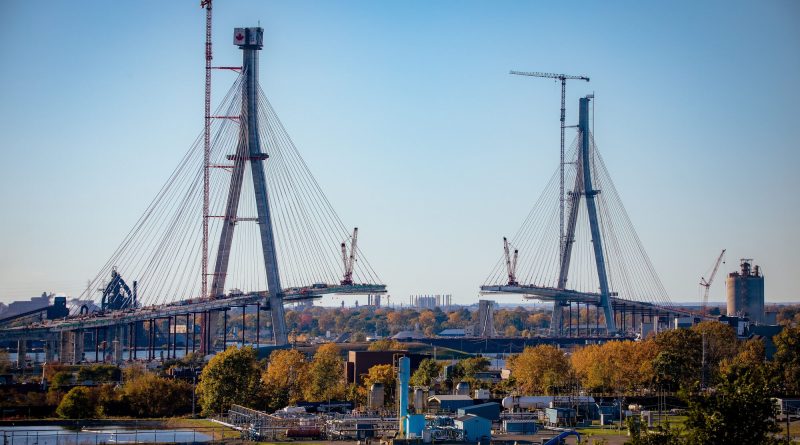
The Gordie Howe International Bridge opens at a pivotal moment for trade
Subscribe to our free newsletter today to keep up to date with the latest construction news.
The opening of the Gordie Howe International Bridge marks far more than the completion of one of North America’s largest infrastructure projects. Stretching across the Detroit River between Windsor, Ontario, and Detroit, Michigan, the crossing arrives after years of engineering, political negotiations and construction, only to enter service during another period of uncertainty for cross-border trade.
Its timing is difficult to ignore. The bridge officially opened to traffic on July 27 as renewed tariff measures introduced by the Trump administration once again raised questions about the future of North American manufacturing and logistics. While infrastructure projects are typically judged by their engineering achievements, this one immediately finds itself tested by changing economic policy rather than concrete and steel.
For the construction industry, the Gordie Howe International Bridge demonstrates how infrastructure investment increasingly sits at the intersection of engineering, politics and economic resilience. The project illustrates both the complexity of delivering major civil works and the long-term value governments continue to place on transport networks that support manufacturing, freight and international commerce.
A bridge designed to strengthen North America’s industrial backbone
For decades, the Ambassador Bridge has carried most commercial traffic between Detroit and Windsor. As one of North America’s busiest border crossings, the corridor supports automotive production, advanced manufacturing and thousands of daily freight movements connecting suppliers across Canada, the US and Mexico.
The Gordie Howe International Bridge was conceived to address growing capacity concerns while providing a modern crossing capable of supporting future trade volumes. Costing approximately C$6.4 billion, the project is one of Canada’s largest infrastructure investments. It includes the cable-stayed bridge, extensive border inspection plazas, highway connections and customs facilities.
Construction began in 2018 after years of legal challenges, environmental reviews and political debate. Delivering a project of this scale required coordination between governments, contractors, engineers and regulatory agencies on both sides of the border. The result is a crossing designed to improve freight efficiency, reduce congestion and provide greater resilience for supply chains that depend on reliable transport links.
From a construction perspective, the bridge showcases advances in long-span bridge engineering, digital project management and international collaboration. It also reflects growing emphasis on infrastructure that accommodates future traffic growth while meeting modern environmental and operational standards.
Its value extends well beyond transportation. Manufacturing sectors across North America rely on tightly integrated supply chains where components often cross international borders several times before final assembly. Even modest improvements in border efficiency can reduce delivery times, inventory requirements and operating costs.
Infrastructure meets geopolitics as tariffs return
The bridge’s opening coincides with renewed trade tensions following the return of tariff measures affecting imported goods. For manufacturers, logistics providers and construction firms, the timing highlights a familiar reality. Physical infrastructure may be designed for decades of service, yet the commercial environment surrounding it can change quickly.
Tariffs rarely reduce the need for transport infrastructure. Instead, they reshape freight flows, sourcing strategies and investment decisions. Manufacturers may diversify suppliers, relocate production or adjust inventory levels, all of which influence demand for transport networks and border crossings.
Against that backdrop, the Gordie Howe International Bridge represents more than additional capacity. It is an investment in supply chain resilience. Businesses operating across North America continue to prioritize flexibility after the disruptions of recent years. Additional border capacity provides greater redundancy if congestion, maintenance or unexpected events affect existing crossings.
For construction companies, the project also illustrates why governments continue investing in major transport infrastructure despite changing political priorities. Bridges, highways and ports are long-term assets that extend well beyond election cycles and economic fluctuations. Their value often becomes most apparent during periods of uncertainty when dependable infrastructure supports business confidence.
The long view for construction and infrastructure investment
Political debate may dominate today’s headlines, but the Gordie Howe International Bridge is a multi-generational infrastructure asset. Its construction required years of planning, international cooperation and technical expertise, all intended to support economic activity for decades.
The project also provides lessons for future megaprojects. Cross-border collaboration, integrated planning and sustained public investment remain essential when delivering infrastructure serving multiple stakeholders. As governments seek to strengthen supply chain resilience and support domestic manufacturing, comparable investments are likely to remain high on the agenda.
For the construction sector, the bridge reflects a broader shift. Infrastructure is no longer judged solely by engineering performance. It is also evaluated by its contribution to economic resilience, supply chain reliability and long-term competitiveness.
As freight begins moving across the new crossing, the Gordie Howe International Bridge enters service during one of the most closely watched periods for international trade in recent years. Whether tariff policies evolve or supply chains continue to adapt, the bridge has already achieved one objective. It has expanded the physical capacity connecting two of North America’s most important industrial regions, providing infrastructure designed to support commerce well into the future.
Source