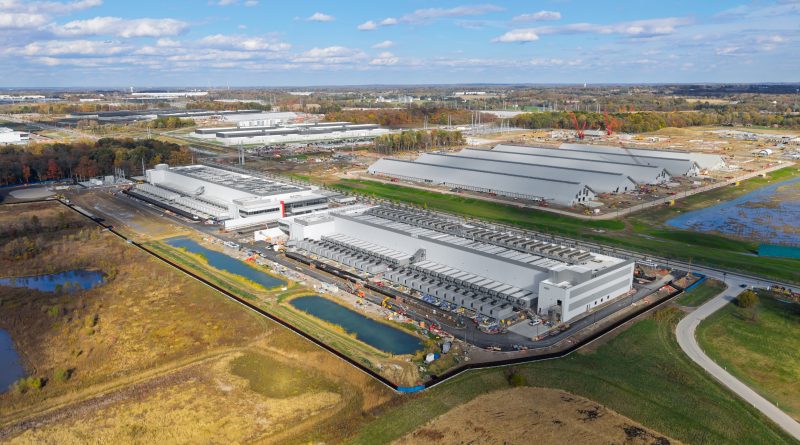
The AI boom is creating a construction hiring race across America
Subscribe to our free newsletter today to keep up to date with the latest construction news.
Artificial intelligence has spent the last three years framed as a white-collar disruption story. Silicon Valley executives promised productivity gains while economists debated which office jobs could disappear first. A second labor story is now emerging far from software campuses and corporate headquarters.
Some of the fastest-growing beneficiaries of the AI economy increasingly work with concrete, steel, cooling systems and electrical wiring.
A wave of spending on data centers, semiconductor plants and energy infrastructure is driving one of the strongest construction hiring cycles in decades. Across the US, contractors are racing to recruit electricians, welders, HVAC technicians and industrial engineers capable of building the physical systems required to support AI computing demand.
The shift is reshaping assumptions about who benefits from the AI economy and where labor shortages may emerge next.
AI infrastructure has triggered one of the largest construction booms in decades
The generative AI race has created extraordinary demand for computing capacity. Every major AI model requires enormous processing power, storage and cooling infrastructure. That demand is translating into billions of dollars flowing into industrial construction projects across the US.
Technology companies including Microsoft, Amazon, Meta and Google continue expanding hyperscale data center footprints at a pace the construction industry has struggled to match. Moody’s estimates global AI-related infrastructure investment could reach roughly $3 trillion over the next five years, creating ripple effects across energy, logistics and construction supply chains.
The projects themselves are highly specialized. AI data centers require advanced electrical systems, industrial-grade cooling networks and uninterrupted energy supply. Building them often resembles constructing manufacturing plants rather than traditional office buildings.
Northern Virginia remains the largest US data center market, though growth has accelerated across Texas, Ohio, Arizona and parts of the Midwest where land and electricity are more accessible. Entire regional economies are beginning to reorganize around infrastructure development tied to AI expansion.
Construction firms say the labor challenge has become immediate. Demand for skilled trades workers now exceeds available supply in many markets, particularly for licensed electricians and HVAC specialists with industrial experience.
Some firms already offer premium wages, signing bonuses and accelerated apprenticeship programs to secure labor before projects break ground.
Electricians, HVAC technicians and welders are becoming central to the AI economy
The irony of the AI labor market is becoming harder to ignore. While software automation threatens portions of administrative and entry-level office work, many physical trades are gaining bargaining power.
Electricians capable of working on large-scale data center projects can now command salaries once associated primarily with engineering or finance careers. Industry recruiters report experienced workers on complex infrastructure projects increasingly earning six-figure incomes, particularly when overtime and travel incentives are included.
HVAC specialists have also become critical because cooling systems now sit at the center of AI economics. Advanced chips generate immense heat loads, forcing operators to invest heavily in thermal management systems. The more powerful AI models become, the greater the cooling challenge grows.
At the same time, the workforce pipeline remains constrained.
The construction industry faces an aging labor base, with many experienced tradespeople nearing retirement. BlackRock recently warned labor shortages could become one of the largest obstacles to AI infrastructure expansion. Some estimates suggest the US construction sector may need hundreds of thousands of additional workers annually to meet projected demand.
Trade schools and apprenticeship programs are beginning to attract renewed interest after years of cultural emphasis on four-year university pathways. Some economists believe the AI buildout could accelerate a broader reevaluation of vocational education and industrial careers.
The timing also carries political significance.
For years, policymakers worried automation would erode middle-income employment. Instead, parts of the AI economy may strengthen demand for labor categories that previously struggled with recruitment shortages.
The AI labor market is splitting into two very different economies
The broader employment picture remains uneven.
Many technology and finance companies continue reducing hiring for junior white-collar roles while increasing spending on automation software. Entry-level analysts, coordinators and administrative workers face mounting pressure as AI systems absorb repetitive tasks once handled by human employees.
Physical infrastructure work remains difficult to automate at scale.
Construction sites still require coordination, adaptation and specialized manual labor under changing conditions. Robotics adoption continues advancing slowly compared with software automation. The labor market is increasingly dividing between automatable digital tasks and high-demand physical work tied to infrastructure expansion.
That divide could reshape workforce planning across industries.
Community colleges, union apprenticeship programs and technical schools may gain strategic importance if AI investment continues accelerating. Several states already offer incentives designed to expand skilled trades training tied to semiconductor manufacturing and energy infrastructure.
The labor implications extend beyond construction alone. Utilities, transportation companies and industrial suppliers are also expanding hiring as AI projects place additional strain on regional infrastructure systems.
The next bottleneck for AI growth may not be chips but workers
For technology executives, the next challenge may extend beyond securing advanced semiconductors.
The AI economy increasingly depends on labor-intensive physical systems that take years to develop. Data centers require permits, land acquisition, grid upgrades and specialized construction crews long before AI models reach consumers.
Power availability has already emerged as a major concern in several fast-growing markets. Utility operators warn electricity demand from AI facilities could place significant pressure on transmission systems and generation capacity over the next decade.
Labor shortages only compound those pressures.
If enough electricians, engineers and industrial contractors cannot be recruited quickly, project timelines may slip despite strong corporate spending. That creates a paradox for the AI industry. The digital economy’s growth increasingly depends on physical labor categories many investors previously overlooked.
The result is a labor market dynamic few predicted when generative AI first entered public discussion.
The next phase of the AI economy may be built less by coders alone and more by the workers pouring foundations, upgrading substations and wiring massive industrial facilities across the country.
Source