Spiniello Companies combines trenchless technology and heavy civil expertise to modernize critical water and wastewater infrastructure
When DC Water set out to rehabilitate the Potomac Interceptor, a 54-mile regional sewer system carrying wastewater from Virginia and Maryland to Blue Plains, Spiniello Companies (Spiniello) stepped in to help solve one of the region’s most significant infrastructure challenges. In the first year of a $625 million, ten-year initiative, Spiniello is already working on more than 10,000 linear feet of 78-inch interceptor. The team uses cured-in-place pipe (CIPP) lining, geopolymer lining, and sliplining technologies, choosing what best fits each section of the project. This program showcases Spiniello’s approach to pipeline rehabilitation and construction, which has operated for over a century with a core philosophy: don’t force one technology onto every job. Luis Best, Spiniello’s Chief Operating Officer, explains, “We’re not trying to sell a particular technology. We work to understand the owner’s problem first and then find the right solution.”
Founded in 1922, Spiniello has grown from its heavy civil origins into one of the country’s most versatile water and wastewater infrastructure contractors. Headquartered in New Jersey and employing over 400 professionals, the company now operates across the Northeast, Mid-Atlantic, and West Coast. Even with this growth, Luis points out that construction remains a people business at Spiniello. “Our success comes from the project managers, superintendents, foremen, workforce, and support teams who execute these projects every day, along with the vendors and industry partners who back them.” As COO, he oversees operations, making sure people, resources, and systems align to get the job done safely.
Greater control
While Spiniello started with heavy civil construction and excavation, the company has greatly expanded the range of solutions it offers clients. “We have strong roots in heavy civil construction and excavation, but we’ve also built a broad portfolio of trenchless technologies on that foundation,” Luis explains. “Now, we can look at an infrastructure problem from several angles to find the best fit for each project. That’s a key part of who Spiniello is today.”
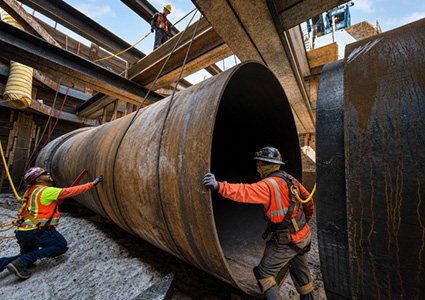
Spiniello’s expertise falls into two main areas: trenchless technology rehabilitation and heavy civil construction. On the trenchless side, Spiniello’s primary rehabilitation technologies include CIPP lining, sliplining, geopolymer lining, cement mortar lining, gunite, and shotcrete, supported by capabilities such as bypass pumping, cleaning, CCTV inspection, and condition assessments. For heavy civil projects, Spiniello handles major water and wastewater excavation, pipeline replacement, deep excavations such as access pits and shafts, and all the supporting civil work that goes with those systems. “The combination matters because a complicated rehabilitation project is rarely just about installing a liner,” Luis observes. “You might need an access shaft anywhere from 30 to 100 feet deep, major bypass pumping, and extensive cleaning and utility relocation before the rehabilitation technology can even begin.”
That ability to integrate and self-perform critical work gives Spiniello greater control over safety, schedule, cost, quality, and interface risk on complex projects. “With the type of work we do, safety must be part of operations from day one,” Luis adds. “Whether we’re planning a deep excavation, confined-space work, a major bypass system, or working around live infrastructure, safety has to be built into how we plan the work, assess risk, and execute in the field every day.” Strong relationships with manufacturers and specialty partners support these self-perform capabilities, giving teams access to the materials, equipment, and technical expertise needed for tough jobs.
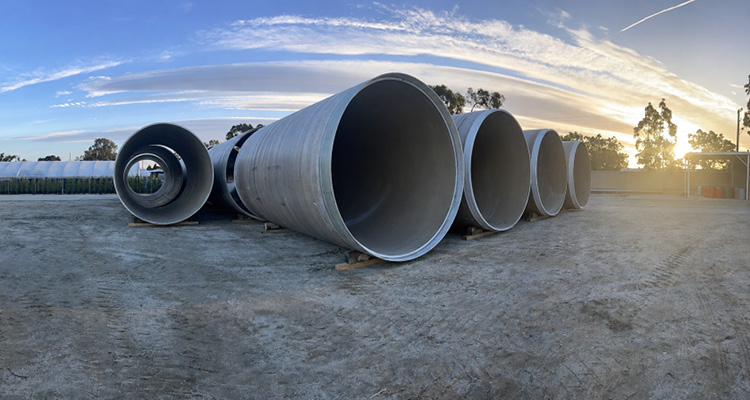
Spiniello’s hands-on experience with the Potomac Interceptor actually began in late 2025, when the company was called upon to rehabilitate approximately 800 linear feet of the 78-inch interceptor during an emergency. The work was particularly challenging because the rehabilitation had to be performed under existing flow conditions without a traditional bypass system. Working under challenging live-flow conditions, the team successfully mandrel-tested and sliplined the existing pipeline with HOBAS fiberglass-reinforced pipe before grouting the annular space. “It was an extremely complex project that required a tremendous amount of planning and field execution. We were brought in because of our experience with large-diameter sliplining and were able to mobilize quickly and successfully complete the rehabilitation under emergency conditions.”
That experience has since carried into Spiniello’s involvement in the broader Potomac Interceptor renewal program. Spiniello is delivering the current work through a Construction Manager at Risk (CMAR) arrangement with DC Water. This model engages operations, project management, engineering, designers, manufacturers, and specialty vendors early to evaluate alternatives and constructability together.
Collaborative approach
Luis credits DC Water’s forward-thinking approach to project delivery as an important part of that process. As the Authority has increasingly embraced collaborative delivery models such as CMAR and progressive design-build, it has created an environment where owners, engineers, contractors, and technical partners can engage earlier, identify risks and constructability hurdles sooner, and work through solutions before they reach the field. On complex, aging infrastructure like the Potomac Interceptor, that approach can help streamline decision-making and address obstacles that are difficult to solve through a traditional design-bid-build process.
“It’s not simply contractor execution after the design is complete,” Luis says. “The influence is very strong early on, prior to construction starting.”
That collaborative, best-for-project approach has proven essential for a project of this scale. Rather than applying a single rehabilitation method across the entire 54-mile system, Spiniello’s crews are assessing pipe condition, alignment, and geometry, section by section. Flow management alone has become significant in its own right, with wet-weather bypass systems designed to handle substantial volumes at scale. “Construction on the first early work package began July 2026. This project represents where infrastructure delivery is heading.” For Luis, the project is proof that infrastructure of this size and importance cannot be solved by any one company. “Collaboration matters,” he affirms. “I give a tremendous amount of credit to our DC project management and field operations teams. They are the ones managing that complexity every day in the field and making these solutions work.”
That same problem-solving approach is evident in Spiniello’s work across the country. One example is Los Angeles’ North Outfall Sewer (NOS) 10, winner of the 2025 Trenchless Technology Project of the Year award. “We are extremely proud of this project. NOS 10 is one of Los Angeles’ critical sewer arteries, and before we began work on this stretch – what the city officially calls Unit 10 – it was approximately 5,000 feet of almost century-old infrastructure. However, this wasn’t a straightforward sliplining project. The alignment included multiple curves and angle points, significant portions beneath private property and active railroad areas, deep access excavations, a unique section known as the squash box, and major bypass requirements,” Luis says.
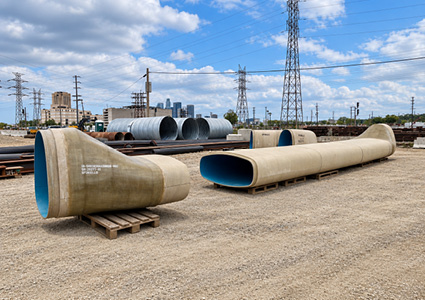
“We rehabilitated the sewer using sliplining technology with a custom fiberglass-reinforced polymer mortar pipe. We used detailed 3D sonar and laser profiling to understand the existing geometry and custom-fabricated approximately 700 individual pipe sections to navigate the alignment. The bypass operation was another major challenge. We had to maintain sewer service throughout construction, which included handling large volumes of flow.” He describes the project as “hundreds of good decisions,” as opposed to one great idea. That’s one of the elements he loves most about the project.
Luis adds, “Our field leadership had to solve problems in real time, and the project management team had to coordinate with the owner, railroads, local businesses, designers, and suppliers. Our vendors had to work alongside us to engineer, manufacture, and deliver specialized materials and equipment where needed. HOBAS USA, Xylem, RedZone Robotics, and Cell-Crete were among the manufacturers and service providers recognized as part of the project group. The award was great recognition, but to me it was really recognition of our entire California team – project management, superintendents, foremen, field crews, and everyone who supported them.”
Solving problems together
That same thoughtful approach applies to Spiniello’s growth strategy. Rather than simply placing dots on a map, the company’s regional expansion is driven by client relationships, infrastructure needs, and the locations where its capabilities can provide the most value. “We want enough regional presence to understand the local market, develop relationships, mobilize efficiently, and build a strong local workforce, while still having access to the resources and technology capabilities of the entire company,” Luis says. “We don’t want separate companies operating under the same name. We want regional crews backed by one Spiniello operating platform. As we grow, project controls, operational technology, and better use of data are becoming increasingly important. Those investments give our workforce better information to make decisions and allow us to scale faster without compromising safety, quality, or the operational discipline that got us here.”
Although Spiniello is successfully expanding across locations, the industry-wide skills shortage is still a real issue. “Finding and developing experienced people is a challenge across our industry, particularly as we continue to grow,” Luis says. “For us, retention starts with giving people an opportunity to build a career rather than simply giving them a job. We want people to see a path forward and have opportunities to progress through operational and management responsibilities. I started with Spiniello as a field engineer and had the opportunity to progress through project management and operational leadership before becoming COO. That’s the kind of opportunity we want to continue creating for people throughout Spiniello.”
Looking ahead, Luis envisions Spiniello continuing to grow strategically and deliberately, expanding into markets where its capabilities genuinely add value, while broadening its role in alternative delivery models such as CMAR and progressive design-build. The approach being demonstrated on the Potomac Interceptor, bringing construction expertise, technology alternatives, and field experience into the process earlier, is one Spiniello believes can create significant value for owners facing increasingly complex infrastructure challenges. As infrastructure ages and becomes increasingly difficult to rehabilitate without disrupting the communities it serves, he believes the need for contractors who can combine engineering, trenchless expertise, and heavy-civil delivery will only increase. But for Spiniello, one principle will outlast any new technology. “Success comes from putting the right people and partners around the table, giving them quality information, and allowing them to solve the problems together. We’ve been doing this for more than 100 years now, and I don’t think that fundamental principle is likely to change,” Luis concludes.