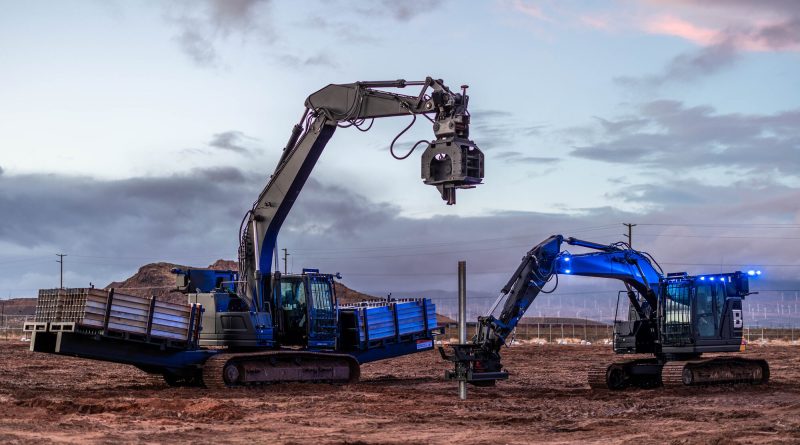
Robots are building the solar farm powering Meta’s Louisiana data center
Subscribe to our free newsletter today to keep up to date with the latest construction news.
The AI boom has triggered a race to build infrastructure at a pace the construction industry has rarely experienced. While headlines often focus on the data centers powering artificial intelligence, an equally significant shift is taking place on construction sites. Autonomous heavy equipment is beginning to take on repetitive, labor-intensive work, offering contractors a way to deliver increasingly complex projects faster and with greater consistency.
A clear example is emerging in Louisiana, where Built Robotics has deployed autonomous piling machines to help construct a utility-scale solar farm supporting Meta’s Hyperion AI data center. The project signals that construction robotics is moving beyond trials into large-scale commercial use, driven as much by labor shortages as technological progress.
The AI boom is accelerating demand for autonomous construction robots
Artificial intelligence has become one of the biggest catalysts for infrastructure investment in decades. Technology companies are committing billions of dollars to new data centers, each requiring vast amounts of electricity, cooling capacity and supporting infrastructure. Meeting that demand extends far beyond constructing server halls. It also requires substations, transmission networks and renewable energy projects capable of supplying reliable power around the clock.
Meta’s Hyperion campus in Louisiana illustrates the scale of that challenge. The first phase is expected to consume around two gigawatts of electricity, creating demand for substantial renewable energy capacity. To help meet those requirements, contractors are building a utility-scale solar farm where autonomous robots are carrying out one of the project’s most repetitive tasks: driving steel foundation piles into the ground.
Built Robotics has deployed approximately 10 autonomous machines that install close to 1,000 steel piles each day. Operating for more than 12 hours, the 72-ton machines use GPS, onboard sensors and machine intelligence to position themselves with minimal human input while maintaining consistent accuracy.
The technology arrives at a time when contractors continue to struggle to recruit skilled workers. The Associated Builders and Contractors estimates the US construction industry will need roughly 349,000 additional workers during 2026 to meet expected demand. Against that backdrop, autonomous equipment is being positioned less as a replacement for operators and more as a way to automate repetitive work while allowing experienced personnel to supervise multiple machines and concentrate on higher-value tasks.
Construction automation is moving beyond pilot projects
Construction has historically adopted automation more slowly than manufacturing. Every project presents different terrain, weather conditions and site constraints, making it far harder to standardize robotic systems than production lines inside a factory.
That is beginning to change.
Rather than developing entirely new machinery, companies such as Built Robotics retrofit conventional heavy equipment with autonomous operating systems. Excavators, pile drivers and other machines retain their mechanical capabilities while gaining navigation, perception and decision-making software.
The approach is particularly effective for repetitive tasks requiring precision. Installing hundreds of identical steel foundations across a solar development depends on accuracy and consistency rather than continual operator judgment, making it well suited to autonomous operation.
Human oversight, however, remains central. Site teams continue to establish work zones, monitor operations and intervene when conditions change. Instead of manually controlling every movement, operators increasingly supervise fleets of autonomous equipment, reflecting a broader shift already seen in manufacturing, logistics and mining.
Automation is becoming a competitive advantage for contractors
The appeal of autonomous construction robots extends well beyond easing labor shortages.
Projects linked to AI infrastructure, renewable energy and advanced manufacturing are being delivered against increasingly demanding schedules. Delays can postpone the completion of assets worth billions of dollars, placing greater pressure on contractors to improve productivity without compromising safety or quality.
Autonomous equipment offers several practical advantages. Machines can operate for longer periods with consistent output, reducing variability between shifts while improving scheduling certainty. Digital operating systems also generate detailed performance data, giving project managers greater visibility into equipment utilization and project progress.
Investment in the sector reflects growing confidence. Built Robotics has expanded its partnership with Blattner Energy through a $75 million agreement and has completed more than 40 commercial deployments, suggesting autonomous construction equipment is gaining traction across major infrastructure projects.
The implications extend well beyond renewable energy. Manufacturing facilities, logistics hubs, transportation projects and industrial developments all face similar pressure to build faster while managing workforce constraints. As investment in AI infrastructure continues to accelerate, construction automation is likely to become an increasingly important competitive advantage.
The debate surrounding autonomous robots often focuses on whether machines will replace people. The projects now taking shape suggest a more practical reality. As demand for data centers, renewable energy and industrial capacity continues to grow, the greater challenge may simply be building quickly enough. Autonomous construction robots are emerging as one of the industry’s most effective tools for meeting that demand while allowing skilled workers to focus where their expertise delivers the greatest value.
Source
Photo credit