How contractors are delivering the $16 billion Hudson Tunnel Project
Subscribe to our free newsletter today to keep up to date with the latest construction news.
After more than a decade of planning, financing negotiations and preparatory construction, the Hudson Tunnel Project has moved into one of its most consequential engineering phases as tunnel boring begins beneath the Palisades between New Jersey and New York.
The start of excavation marks a transition from planning and enabling works into sustained underground production, where progress will increasingly be measured by the amount of rock removed, concrete lining installed and construction packages successfully connected across a complex rail corridor.
With an estimated cost of roughly $16 billion, the project is designed to deliver a new two-tube rail tunnel beneath the Hudson River before the existing North River Tunnel is rehabilitated one tube at a time. The scale of the work places the project among the most significant rail infrastructure programs underway in the US, but its importance is tied as much to operational resilience as to its construction value.
The existing tunnel carries Amtrak and NJ Transit services through one of the busiest sections of the Northeast Corridor, leaving little room for prolonged closures or major disruption while replacement infrastructure is built.
The first machines face a mile of Palisades rock
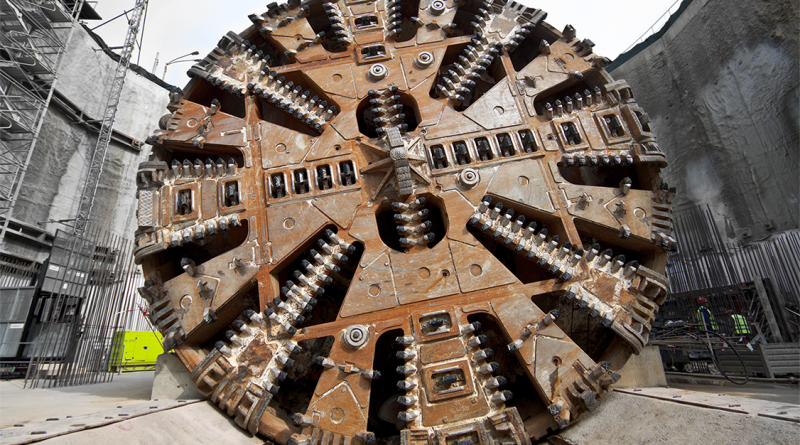
The initial excavation is being carried out by two tunnel boring machines designed to cut approximately one mile through the Palisades between North Bergen and the Hudson County Access Shaft in Weehawken.
Manufactured by Germany-based Herrenknecht, the single-shield hard-rock machines each weigh more than 1680 tons and use cutterheads measuring 28 feet, 8 inches in diameter. Behind the excavation equipment, a trailing gantry extending approximately 500 feet carries much of the machinery and infrastructure required to support continuous tunneling.
At the front of each TBM, disc cutters mounted on the rotating cutterhead press against the rock face until the material fractures into smaller pieces. The broken rock is collected and transported through the machine for removal, while precast concrete segments are assembled behind the cutterhead to form the permanent tunnel lining.
Hydraulic thrust systems push against the completed lining and move the machine forward into the next section of rock, creating a production cycle in which excavation, spoil removal and tunnel construction take place in close sequence.
Although the process is highly mechanized, tunneling performance still depends on geological conditions, equipment reliability, maintenance schedules and the steady movement of materials to and from the excavation face.
Project teams expect the machines to advance at an average rate of about 30 feet per day, including planned maintenance periods. At that pace, the journey through the Palisades is expected to take approximately a year before the machines reach the access shaft in Weehawken.
Their arrival will mark the end of one construction stage rather than the completion of the underground route. The hard-rock TBMs are designed specifically for the Palisades and will eventually be removed so that another pair of machines, configured for the ground conditions beneath the Hudson River, can continue the tunneling program toward Manhattan.
This change in equipment reflects one of the project’s central engineering challenges. The route crosses different geological conditions, meaning contractors cannot rely on a single tunneling method or machine configuration from New Jersey to New York.
The project depends on much more than excavation speed
The dimensions of the TBMs make them the most visible pieces of machinery on the project, but excavation accounts for only one part of a construction program spread across several major contracts and work sites.
The Hudson Tunnel Project includes the Palisades Tunnel, the Hudson County Access Shaft, the river crossing, Manhattan tunneling, ground stabilization, surface alignment work in New Jersey and supporting construction around Hudson Yards.
Dividing the work into separate packages allows multiple parts of the project to advance simultaneously, although it places considerable pressure on planning, scheduling and technical coordination because each section must ultimately connect within tight engineering tolerances.
Tunnel drives must arrive accurately at shafts and adjoining structures, surface works must connect with existing rail infrastructure and civil construction must eventually accommodate track, signaling, electrical power, ventilation, communications and emergency systems.
The river section brings a different set of construction requirements, including ground stabilization and preparatory work intended to support safe tunneling beneath the Hudson. Those underground works must connect with the access shaft in Weehawken before continuing toward Manhattan and the approaches to Penn Station.
The resulting construction sequence shows why excavation speed alone cannot determine the performance of a major tunneling program.
A TBM may be capable of advancing at its planned rate, but sustained production depends on the availability of precast tunnel segments, replacement cutting tools, spare parts, electrical systems, maintenance crews and reliable spoil-removal capacity. Surveying and monitoring systems must keep the machine on its intended alignment, while logistics teams must maintain a steady flow of materials without obstructing work underground.
That requirement gives the project a substantial supply-chain dimension. Large tunneling programs consume fabricated steel, concrete products, electrical equipment, pumps, ventilation systems, communications hardware, rail components and specialist machinery over several years.
For contractors and suppliers, the Hudson Tunnel Project is therefore not simply an excavation job but an extended exercise in industrial coordination, where interruptions in one part of the system can affect production elsewhere.
A century-old rail bottleneck raises the stakes
The complexity of the project is driven partly by the condition and importance of the infrastructure it is intended to supplement.
The existing North River Tunnel, which carries Amtrak and NJ Transit trains beneath the Hudson, is more than 110 years old and sustained extensive damage when Superstorm Sandy pushed saltwater into the structure in 2012.
Despite its age and condition, the tunnel remains one of the most important rail connections on the Northeast Corridor, carrying about 200,000 passengers between New Jersey and New York each day.
Replacing that capacity without shutting down the existing connection shapes much of the project’s construction strategy.
The new tunnel is intended to provide two additional tracks beneath the Hudson. Once those tracks are operational, the existing North River Tunnel can be taken out of service one tube at a time for rehabilitation, allowing passenger trains to continue crossing the river while the century-old infrastructure is repaired.
The objective is therefore broader than replacing old infrastructure with new construction. The project is intended to create enough capacity and redundancy for major maintenance to take place without severing a rail connection that is central to regional and intercity passenger operations.
Financing reflects the scale of that task, with federal grants and financing commitments accounting for about $11 billion of project support.
The project has already shown how closely megaproject delivery can be tied to funding decisions, regulatory processes and political conditions. Physical construction may take place underground, but the pace of delivery depends on decisions made across public agencies, contractors, lenders and government institutions.
Against that background, the start of tunnel boring has greater significance than the arrival of two large machines.
Years of environmental review, engineering design, procurement, financing and enabling works are now being converted into permanent underground structures. The project is entering a stage where construction performance becomes increasingly visible, allowing progress to be judged against excavation rates, interface schedules and the ability of numerous contractors and suppliers to deliver their work in sequence.
The machines beneath the Palisades are only beginning that process, but their advance will provide one of the clearest measures yet of whether one of the largest rail infrastructure programs in the US can translate its design and funding commitments into a functioning transportation asset.
Source:
6sqft