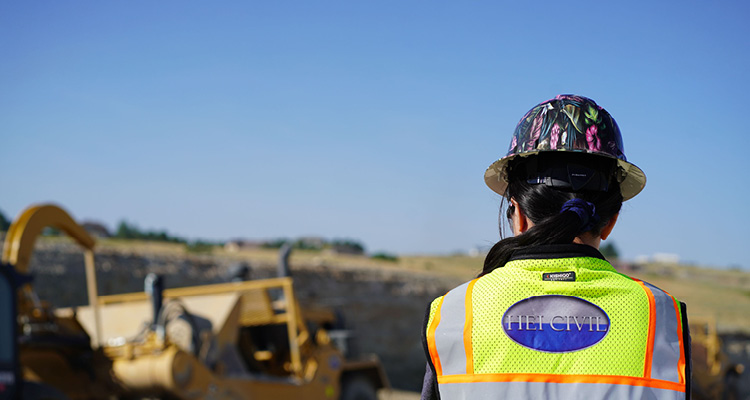
HEI Civil transformed from a local excavating contractor into a multi-state infrastructure construction business
From humble beginnings as a basement-digging and residential grading contractor in Colorado, HEI Civil has evolved into a multi-state heavy civil business with the capabilities, workforce, and operating structure to deliver infrastructure projects across the Southwest and Southeast. Today, the company performs everything from mass grading and utility installation to roadway construction, bridges, concrete structures, and site development.
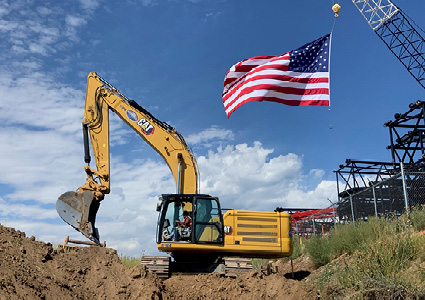
The transformation has unfolded over more than five decades. What began as a local excavating company expanded into municipal, transportation, commercial, and infrastructure markets, broadening its service offering while building the leadership structure necessary to support a much larger organization.
JP Morgan understands this growth firsthand. He joined HEI Civil in 2004 as an estimator and project manager, back when the company’s revenue ranged between $5 million to $10 million annually. Now, as Chief Operating Officer and one of the company’s owners, JP leads operations across several states, with the team working toward its next milestone: $500 million in annual revenue.
Despite that progress, JP rarely frames the company’s story around numbers alone. Instead, he highlights the foundation built by founders Bill and Dan Hudick. “Dan and Bill did a great job of building the foundation, establishing a fleet, creating our culture, and giving us a strong base to grow from. We also have some outstanding leaders here. The company is in good hands,” JP notes.
JP’s answer reveals a core value. For all the talk about revenue, geography, and capabilities, he credits HEI Civil’s progress to the people who built the company before it expanded beyond Colorado. The company looks different than it did in 1973, but leadership remains focused on preserving the culture, accountability, and relationships that have fueled its growth.
The business built on that foundation now extends far beyond its original excavation roots. HEI Civil handles earthmoving, utilities, highways, bridges, drainage systems, concrete structures, traffic control, blasting, and industrial projects. The company self-performs much of this work, giving it greater control in the field.
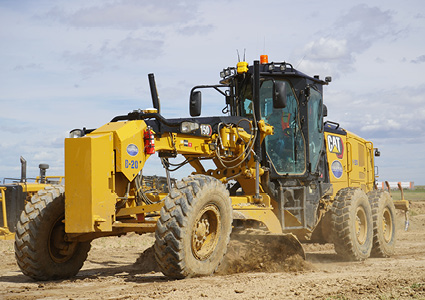
Its fleet includes late-model Caterpillar scrapers for mass grading and haul trucks operating in both North Carolina and Texas. In Colorado, HEI Civil delivers design-build bridge work and self-performs concrete structures such as box culverts and inlets. The team also manages blasting and traffic control services.
The breadth of its services allows HEI Civil to support a diverse client base across multiple markets. Harley Swain, marketing and communications specialist at HEI Civil, sees that expansion reflected in the projects the company pursues today: “We do a lot of commercial and residential earthmoving, and we’re working with the City of Austin and starting municipal projects in Colorado, too. The company is looking to get involved in more nationwide work,” Swain reports.
Prioritizing people
For JP, however, strategy remains surprisingly straightforward: “Wherever the work is, wherever you can move dirt and put pipe in the ground, that’s where the company is headed,” he notes.
“As opportunities expand, so do the demands on our team,” he continues. “Even something as simple as office space quickly fills up, reminding us how fast we’re growing.” With two buildings currently operating in Castle Rock, Colorado, HEI Civil continues to evaluate future space requirements. “What always seems to happen is we get a new space that’s bigger than we need, and then soon we grow into it. Before we know it, we’ve filled it up and we’re looking for new space again,” JP says.
The pattern has become familiar: prepare for the next stage of the business, then find the business arrives sooner than expected. Systems, leadership capacity, workforce development, and operational processes must all evolve alongside the business itself.
JP applies similar thinking to the company’s relationships with suppliers and subcontractors. In an industry often associated with aggressive bidding strategies, he takes a longer view. “There was a time when GCs would try to make money on their subs’ and suppliers’ backs; take the lowest bid and then squeeze every penny out of them after. That’s not how we roll. We want our subs and suppliers to do well, and we encourage that.”
The standards HEI Civil apply when selecting partners are reflected in the way it measures performance across the business. Rather than relying on broad statements about values, the company uses a framework. “We call the framework Critical Success Factors. The six categories are safety, people, client service, quality, production, and equipment. Not only are they critical to our success, but the degree to which we perform in each category makes us even more successful. Every year we spend time figuring out how we can improve in each one,” JP continues.
The framework serves as a guide for decision-making across the business, creating a common understanding of what success looks like and where improvement efforts should be directed.
Alongside operational priorities sits a set of values summarized through the acronym GRIT. JP shares, “GRIT stands for Growth, Raising the Bar, Integrity, and Teamwork. We feel like those summarize our philosophy.”
Those values become tangible in the company’s approach to safety and workforce wellbeing. JP consistently links safety to people, arguing that strong performance begins with creating an environment where employees can succeed. “We have a history of performing well in the category of safety. Safety and people are closely related. It’s about taking care of our people. We came up with six initiatives we want to advance. We’re developing KPIs, building a more robust occupational health program, and developing safety recognition programs that drive results,” JP elaborates.
Sustainable growth
Beyond expanding occupational health resources, HEI Civil is exploring telehealth capabilities and continuing to build on initiatives such as early intervention and defensive driving. The objective is not simply to reduce incidents, but to support employees throughout their careers.
Ultimately, what stands out most about JP’s leadership philosophy is his view of experience itself. While studying construction management at Colorado State University, he remembers a professor warning students that costly mistakes would be part of their professional development. Years later, the lesson continues to influence how he thinks about leadership: “Mistakes in construction can be looked at as an education. If you learn from them, you can prevent them from happening again. Better still, share those lessons with the people coming up in the industry so everyone can learn from the same mistake. I think that’s super important,” JP reflects.
In many ways, the observation mirrors HEI Civil’s own evolution. The company that began by digging basements did not arrive at its current position through a single breakthrough. It built capability over time, expanding its expertise, developing its people, and carrying lessons forward from one stage of its development to the next.
As the business considers its next chapter, JP’s view of the future remains consistent with the approach that has defined the company’s journey so far. “I think generally we want to keep expanding and growing. I can see us being successful at that because that’s what we’ve been doing,” JP concludes.