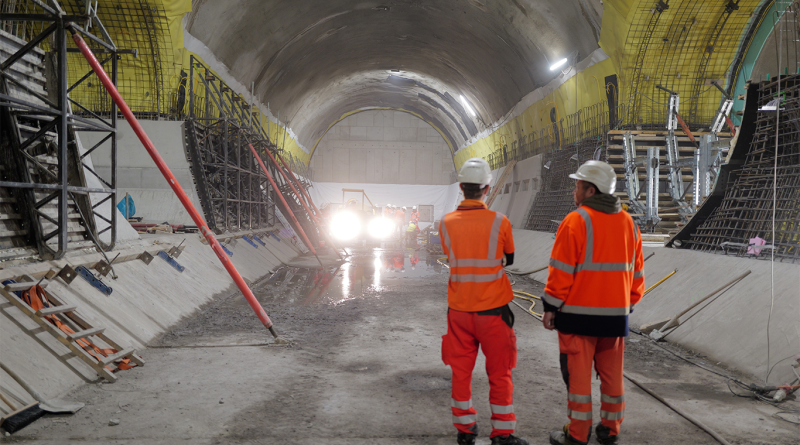
Granite-Super wins $325m Big Creek Tunnel contract
Subscribe to our free newsletter today to keep up to date with the latest construction news.
Granite Construction and Super Excavators have won a $324.8 million contract to build Cleveland’s Big Creek Tunnel, placing the final large-diameter storage tunnel planned under the Northeast Ohio Regional Sewer District’s Project Clean Lake program into the construction pipeline.
The Granite-Super joint venture will construct 22,300 ft of 20-ft-diameter main tunnel and another 3,115 ft of ancillary tunnels. Its scope reaches well beyond the main bore, covering shafts, diversion structures, gate and screening facilities, control vaults, consolidation sewers, an overflow box culvert, utilities and restoration.
Once the system enters service, NEORSD expects it to prevent about 550 million gallons of combined sewer overflow from reaching Big Creek and its tributaries each year. That figure puts the $324.8 million award in a broader context: this is an underground storage project designed around measurable reductions in wet-weather pollution rather than tunneling capacity alone.
A $324.8 million contract built around deep tunneling
Big Creek will run for more than four miles through rock beneath Cleveland, Linndale and Brooklyn, generally at depths of about 50 to 100 ft. Seven shaft sites will connect construction activity at the surface with the tunnel alignment below, concentrating many of the project’s most visible effects at individual work zones.
The system is designed to collect combined sewage from 11 overflow outfalls. In older combined sewer networks, sanitary sewage and stormwater share the same pipes. Heavy rainfall can push those networks beyond available conveyance or treatment capacity, leading to controlled releases into nearby waterways. Storage tunnels create temporary capacity underground so part of that flow can be retained and sent for treatment later.
Granite’s package includes adits, an overflow tunnel, connecting tunnel and dewatering tunnel in addition to the main 20-ft-diameter drive. Multiple shafts, diversion structures, gates and screening facilities will connect that underground network with existing sewer infrastructure.
NEORSD expects the main tunnel to be excavated using a tunnel boring machine, allowing most of the alignment to be constructed without opening a continuous trench through the communities above. The approach reduces the surface footprint across much of the route, though major shaft sites and supporting works will still affect traffic and surrounding neighborhoods.
Ridge Road at Memphis Avenue in Brooklyn is expected to operate with one lane in each direction for about nine months during part of the construction period. West 37th Street in Cleveland will face a temporary closure between Memphis and Stanford avenues, with other sites subject to lane restrictions, construction traffic or extended work hours.
The schedule carries a small but relevant difference between the contractor and client. Granite expects construction to begin in fall 2026 and finish in winter 2030, while NEORSD says construction should begin in late 2026 and continue into 2031. Both schedules are current published positions, making attribution preferable to treating either date as a definitive project handover.
For Granite, the award adds another large underground infrastructure package to its order book and will be recorded in third-quarter committed and awarded projects. For the joint venture, the technical challenge will combine long-distance rock tunneling with shaft construction and connections to operating wastewater infrastructure in a dense urban setting.
Big Creek closes out Cleveland’s seven-tunnel strategy
Big Creek’s larger significance comes from its place at the end of Project Clean Lake’s seven-tunnel sequence.
The program grew from a federal consent decree that became effective in 2011 and set out a long-term plan to reduce combined sewer overflows into Lake Erie and other waterways across Greater Cleveland. Large storage tunnels form the most visible engineering component, supported by treatment plant upgrades, collection system improvements and green infrastructure.
Four of the seven tunnel systems, Euclid Creek, Dugway, Doan Valley and Westerly, are already operational. Shoreline and Southerly moved into later construction phases, leaving Big Creek as the final large-diameter storage tunnel scheduled to enter construction.
By December 2025, NEORSD reported that 76 of the 78 planned Project Clean Lake projects were completed or active. Its March 2026 program update put spending and awarded work above $2.4 billion, with nearly $600 million in reported savings through value engineering.
Completed consent decree work was already preventing about 2 billion gallons of overflow from entering the environment annually, according to NEORSD. Big Creek is designed to reduce overflow volumes in its own service area by about 550 million gallons a year, a sizable addition to the reductions already delivered by earlier projects.
Those figures shift the focus away from the dimensions of the tunnel itself. A 20-ft diameter and four-mile alignment define the construction challenge, but they do not define its operating value. The case for the project rests on the amount of sewage that can be intercepted during storms and kept out of Big Creek, its tributaries and the wider Lake Erie watershed.
The contract also illustrates the duration of large urban wastewater programs. Project Clean Lake began in 2011, yet its final major storage tunnel will remain under construction into the next decade. That timescale reflects the complexity of redesigning underground systems that must continue operating while new capacity is excavated and connected around them.
For Granite and Super Excavators, Big Creek is a $324.8 million tunneling contract requiring deep excavation, multiple shafts and extensive interface work. For NEORSD, it represents the closing major tunneling chapter of a program built around seven large underground storage systems.
When construction is complete, the strongest measure of performance will not be how much rock was excavated. It will be whether the new capacity delivers the roughly 550 million gallons of annual overflow reduction that the district has designed it to achieve.
Source:
Tunnelling Journal