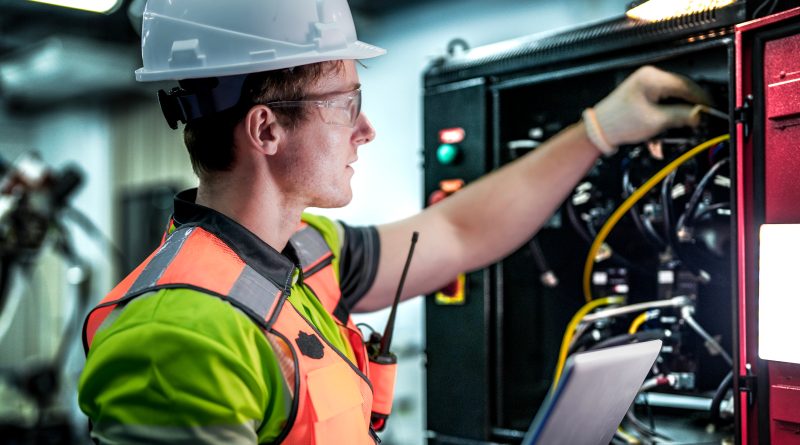
How Google plans to train 300,000 workers for the AI economy
Subscribe to our free newsletter today to keep up to date with the latest construction news.
The artificial intelligence race is often framed as a contest between technology giants competing to build larger models, develop faster chips and secure more computing power. Yet as investment pours into AI infrastructure, another challenge is emerging that has little to do with software or semiconductors.
Google’s recent pledge of $50 million through Google.org to train more than 300,000 skilled trade workers highlights a growing concern across the technology industry. The future of AI may depend as much on electricians, welders and HVAC technicians as it does on engineers and data scientists.
The announcement reflects a broader shift in how technology companies view workforce development. As demand for data centers accelerates across the US, labor shortages are becoming a strategic business issue rather than a recruitment challenge.
The hidden workforce behind the AI economy is becoming increasingly valuable
The rapid expansion of AI requires a vast physical infrastructure network. New data centers must be designed, built and maintained. Electrical systems need to support enormous power demands. Cooling equipment must operate continuously to keep servers functioning efficiently. Fiber networks must connect facilities across regions.
Behind each of these requirements is a workforce that has traditionally received far less attention than software developers or technology executives.
Google’s workforce initiative will support training programs across more than 20 states, working with labor unions and trade associations to prepare workers for careers in electrical work, welding, manufacturing, HVAC installation and fiber-optic technology.
This investment comes at a time when skilled labor shortages are becoming more pronounced. Industry estimates suggest that millions of trade positions could remain unfilled by the end of the decade. For companies investing billions of dollars in AI infrastructure, the inability to find qualified workers presents a risk that cannot be solved through automation alone.
The challenge extends beyond technology companies. Construction firms, manufacturers and utilities are competing for many of the same workers. As data center development increases, demand for specialized labor is expected to intensify across multiple industries.
For years, workforce discussions centered heavily on digital skills. The latest investments from technology companies suggest that physical skills are returning to the center of economic planning.
When labor shortages become a strategic constraint on AI growth
Technology leaders have spent the past two years addressing shortages of advanced chips and computing capacity. Access to graphics processing units became one of the defining competitive advantages in AI development.
Labor is increasingly joining that list.
Building a modern data center requires extensive coordination between contractors, engineers and skilled tradespeople. Delays in construction can postpone the deployment of new AI services and increase project costs. In some regions, workforce availability is becoming a decisive factor when selecting locations for new facilities.
The issue is particularly significant because AI infrastructure projects tend to be concentrated in areas where labor pools are already under pressure. Large-scale developments can require hundreds or even thousands of workers during construction phases.
The result is a competition that extends beyond technology. Companies are effectively competing for talent across construction, manufacturing and industrial services.
Google is not alone in recognizing the problem. Other major technology firms have recently announced workforce initiatives aimed at supporting infrastructure development. Collectively, these efforts suggest that labor capacity is becoming a critical component of AI strategy.
The economics are straightforward. A company can invest billions in land, power agreements and computing equipment, but those investments generate limited value if facilities cannot be completed on schedule.
This dynamic is forcing executives to think more broadly about the foundations of technological growth. Workforce pipelines are increasingly viewed as infrastructure assets in their own right.
Big Tech is redefining workforce development for the AI era
The significance of Google’s announcement extends beyond the dollar amount involved. It signals a growing willingness among technology companies to engage directly in workforce development.
Historically, many corporations relied on educational institutions, unions and government programs to provide skilled labor. Today, businesses are becoming more active participants in building talent pipelines.
Partnerships with labor organizations and trade associations allow companies to influence training programs while expanding access to career opportunities. For workers, these initiatives can provide entry points into industries experiencing sustained demand and competitive wages.
The approach also reflects changing perceptions of skilled trades. Careers in electrical work, manufacturing and industrial maintenance are increasingly linked to some of the fastest-growing segments of the economy.
This shift could have important implications for workforce planning. Younger workers evaluating career options may find new opportunities in sectors connected to digital infrastructure rather than traditional construction projects alone.
Manufacturers may also benefit. Many of the skills required to build and maintain AI infrastructure overlap with those needed across advanced manufacturing environments. Investments in training therefore have the potential to strengthen broader industrial capacity.
As AI reshapes the economy, the conversation around talent is expanding beyond coding and computer science. The people who construct, power and maintain digital infrastructure are becoming central to the industry’s future.
The AI boom is often described as a software revolution. Yet every algorithm ultimately depends on physical facilities, power systems and networks built by skilled workers.
Google’s latest investment reflects an increasingly clear reality. The next phase of AI growth will not be determined solely by advances in technology. It will also depend on whether the workforce exists to build the infrastructure that makes those advances possible.
Source