Downes Construction delivers complex public projects through early planning, partnerships, and execution within active communities
Most public construction projects do not begin with open land or empty buildings. They begin in neigborhoods with traffic patterns, school calendars, and residents who expect normal life to continue while work unfolds around them. Libraries stay open. Campuses remain occupied. Community spaces carry expectations well beyond their walls. Delivering in that environment requires planning that reaches far beyond the jobsite.
Downes Construction (Downes) has built its portfolio inside those conditions. Operating across Connecticut and New England, the employee‑owned firm focuses on civic, educational, healthcare, and community facilities that must function immediately and remain accountable to the people who use them. The projects differ in scale and setting, but they share a consistent non-negotiable: construction that adapts to active public use rather than interrupting it.
That perspective shapes how Downes approaches delivery, from early feasibility and sequencing through construction and handover. “We’re drawn to projects that foster community, like schools, libraries, and recreation centers. These projects align with who we are,” says Tom Romagnoli, President at Downes.
Founded in 1934 and based in New Britain, Connecticut, Downes delivers construction management, general contracting, design‑build, and program management services across New England. Its work often begins well before construction, supporting clients with budgeting, logistics, and coordination that determine whether projects can move forward under real‑world constraints.
Constructing communities
Three recent projects recognized by the AGC Connecticut Build Connecticut Awards illustrate how Downes applies that approach across different environments and delivery conditions.
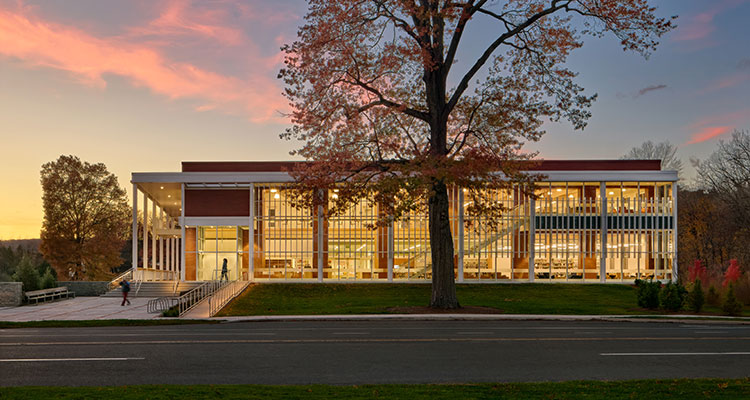
In Bloomfield, Connecticut, Downes delivered the Prosser Library, a civic facility located at a prominent town intersection. The site demanded coordination across two parcels of land and the construction of a pedestrian bridge spanning a brook. Downes joined the project early, assisting with planning, zoning, and permitting. “The Prosser Library really represents partnership and repeat business. We worked with a client and design team we had partnered with before, which allowed trust to build from day one,” Tom explains.
The completed building reflects how libraries now operate as shared public space. While collections remain central, the facility supports programs, gathering, and everyday community use. Sustainability considerations were integrated into planning and construction, with the project designed and constructed to pursue LEED Silver certification. “Libraries today aren’t just about books anymore; they’re community hubs,” Tom adds.
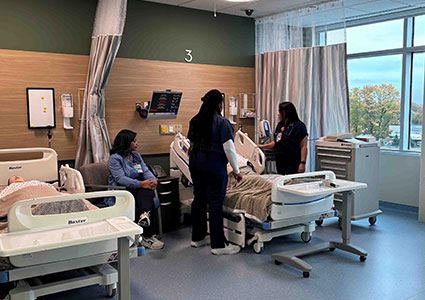
At Goodwin University in East Hartford, Downes delivered a nursing simulation lab shaped by academic scheduling rather than construction timelines. The university needed completion in a short turnaround to support a revised curriculum, with drawings only partially complete at the time of mobilization. “The client came to us with drawings that were about 50 percent complete and said, ‘We need to start immediately, and we need to finish by the end of the summer,’” Tom recalls.
Downes combined its healthcare and higher‑education experience to execute the project. “When clients hire Downes, they’re hiring a partner, not just a builder,” Nicole DeMaio, Vice President, Business Development, Downes Construction affirms. The completed facility expanded from five to 25 simulated hospital beds, supporting hands‑on training for nursing students. “Goodwin supports a diverse student body – both traditional and nontraditional learners, including working and single mothers – and that inclusivity is especially meaningful to us,” Nicole notes.
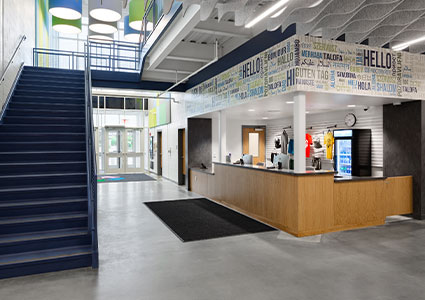
While education projects often hinge on academic calendars, Downes’ civic work introduces a different scale of public expectation. The New London Community Recreation Center, a 58,000‑square‑foot facility delivered over 22 months, followed decades of unsuccessful attempts to bring a full‑service recreation center to the city. Felix J. Reyes, Director of Economic Development for the City of New London, shares, “This project has been a dream for decades. New London is a dense, urban city, and access to indoor recreation is usually a luxury you see in more suburban communities.”
The project called for alignment across funding sources, environmental review, and complex site conditions. Excavation revealed significant unforeseen foundations left from prior development, necessitating additional coordination and adjustment. “We built on a brownfield site and removed about 900 tons of existing concrete foundations. We also dealt with post‑Covid cost escalation and material volatility,” Tom explains.
Despite those challenges, the center opened with amenities previously unavailable to residents, including a swimming pool and flexible gym space. The building now functions as a daily gathering place rather than a destination facility. “The city didn’t have a pool or enough community space. The center brought people together in a prominent part of the city,” Tom reflects.
Smart planning
Downes’ education work further reflects how it manages construction within occupied neighborhoods. At Greeneville Elementary School in Norwich, the firm performed extensive site preparation in close proximity to residential homes. “At Greeneville, we removed roughly 200,000 tons of rock and orchestrated 93 independent blasts, right in the middle of a residential neighborhood,” Tom notes.
Daily coordination with residents, school administrators, and safety officials was essential throughout the work. Blasting schedules and site logistics were communicated openly to maintain trust and minimize disruption. “The community knew when we were blasting. People could hear it, feel it. Our job was to protect the neighborhood, communicate clearly, and keep everyone safe,” Tom adds.
From a municipal perspective, that capacity to anticipate risk plays a central role in whether projects proceed. “Downes helped us forecast costs and risks in a very unpredictable market. On a $42 million project, mistakes don’t cost $10; they cost millions,” Felix observes.
Technology supports that forecasting effort through practical application. Downes uses modeling tools, drone surveys, and project management platforms across its work. “Our drones don’t just take photos; they calculate quantities. They can scan a pile of dirt and tell us how many cubic yards are in it,” Tom points out.
The firm has also begun limited use of artificial intelligence. “We’re cautiously optimistic about AI, especially in estimating and takeoffs,” Tom remarks.
Sustainability follows a similar logic, integrated into execution rather than treated as a discrete feature. “Sustainability starts at the very beginning of the project. Smart planning, sequencing, prefabrication, quality control, and commissioning all help reduce waste and carbon footprint,” Tom explains.
Downes became an Employee Stock Ownership Program company in 2019. In 2025, more than 30 employees reached full vesting, reinforcing shared accountability across the organization. Internal culture initiatives connect that ownership structure to daily operations.
That internal structure directly influences how it approaches relationships beyond its own walls. “When you hire Downes, you’re working with a partner that comes to the table with solutions. In 90 years, we’ve had no litigation with clients or subcontractors,” Nicole shares.
That partnership mindset extends into workforce exposure. On school projects, Downes brings students onto sites and incorporates community engagement into ceremonial milestones. “Kids can’t pursue careers they’ve never seen,” Nicole notes. Tom views those efforts as part of the firm’s role within the industry. “We want to be cheerleaders for what we do. If the industry gets stronger, we all do,” he highlights.
Across Connecticut and the wider New England region, Downes continues to deliver projects defined by context rather than convenience – places that remain active throughout construction and accountable long after completion.