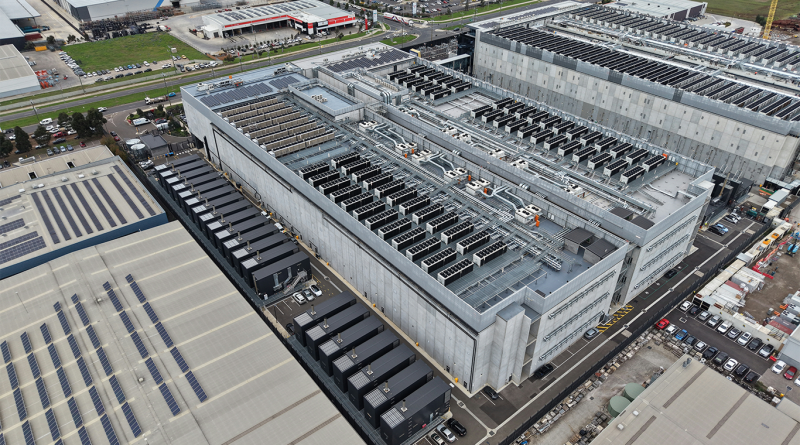
Data center construction costs are rising faster than project size
Subscribe to our free newsletter today to keep up to date with the latest construction news.
Data center construction costs are rising faster than the buildings themselves. ConstructConnect’s November data center report, published Oct. 30, puts the median cost of US data center projects at $540.96 per square foot from January through September 2026, 31% higher than a year earlier.
The same report shows a slower month for new work. Data center construction starts totaled $9.4 billion across 18 US projects in September, less than half of August’s revised record of $25.8 billion. That pulled the 12-month moving average down to $14.9 billion.
One quieter month does little to change the bigger picture. Starts reached $135.8 billion across 178 projects in the first 9 months of the year, and ConstructConnect says 2026 is on pace to exceed $180 billion, roughly $20 billion above its own latest full-year forecast. Data centers now account for 27% of the $500.2 billion in US nonresidential building starts this year.
For contractors, the cost figure may be the more telling number. It suggests the sector’s growth is being driven by more expensive buildings, not simply by more of them.
Data center costs are rising faster than project size
ConstructConnect’s explanation is direct: data centers are getting more expensive faster than they are getting bigger, which pushes up the cost of every square foot. Over 5 years, the median cost per square foot has grown at a compound annual rate of 16.2%.
The average project in the sample now costs $1.3 billion and covers 1.1 million square feet. At that scale, cost per square foot shapes contract values, bonding capacity, and how much risk general contractors and trade partners are willing to carry on a fixed price.
ConstructConnect does not break down what is driving the increase. Its cost analysis covers only projects where both the price and the square footage are known, so the median reflects that sample rather than every data center start in the country.
That caveat matters for anyone using the figure to benchmark bids. The median is a useful signal of direction, but it is no substitute for project-level estimating.
Data center construction is concentrated in 3 regions
The report also makes clear where the work is happening. ConstructConnect says 2026 spending is highly concentrated in 3 areas: the rust belt from Wisconsin through Ohio, with more than $40 billion in starts, the South Atlantic, with $36.2 billion, and the West South Central region, including Texas and Arkansas, with $33.6 billion.
September’s largest starts were 2 projects worth $2 billion each, one in Pennsylvania and one in West Virginia.
The pipeline points further south. ConstructConnect is tracking $74.8 billion across 115 planned projects with expected start dates in the next 6 months. Nearly 80% of that planned spending sits in the South, against 11.9% in the Midwest and 7.2% in the Northeast.
That concentration brings its own pressure for contractors and suppliers. When labor, equipment, and materials are drawn into the same few markets at the same time, competition for each of them tends to rise, which may be one reason cost per square foot keeps climbing.
Power infrastructure is following data center demand
The report also tracks the power work that data centers depend on. Power infrastructure starts grew at an average annual rate of 52.2% between 2021 and 2025, and year-to-date 2026 starts are up 167.4% on the same period last year.
ConstructConnect expects that growth rate to ease, since the comparison will soon include an unusually strong final quarter of 2025. Even so, the figures show data center demand pulling a second stream of construction work behind it.
How long owners will absorb these costs remains unresolved. Planned projects are still in preconstruction, and none is guaranteed to break ground. If owners start to push back on cost per square foot, the next test will be whether the $74.8 billion pipeline converts at the pace of the past 9 months, or whether more of it slips into 2027.
Source
Westside Construction Group