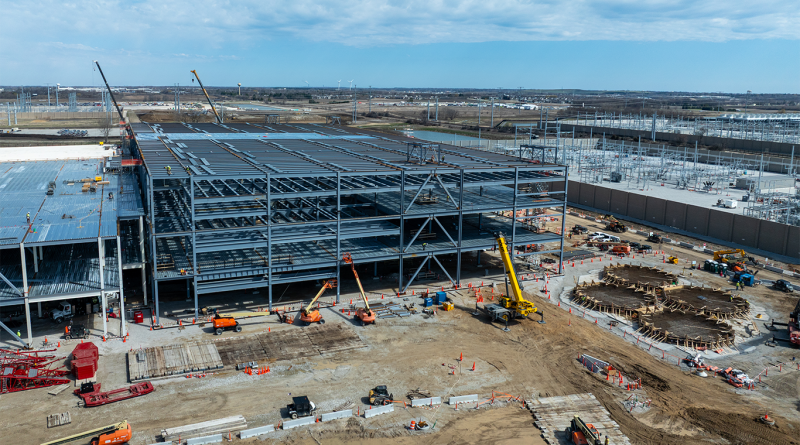
Construction backlog grows as data center investment surges
Subscribe to our free newsletter today to keep up to date with the latest construction news.
The US construction industry entered the final quarter of 2026 with a stronger pipeline of contracted work, supported by continued investment in data centers and technology infrastructure. Yet rising construction costs and weakening profit expectations are creating uncertainty for contractors, suggesting that growing workloads may not necessarily translate into stronger financial performance.
According to Associated Builders and Contractors (ABC), its Construction Backlog Indicator increased to 8.7 months in September, marking the second consecutive monthly increase. The figure was 0.2 months higher than in August and the same period last year, reflecting sustained demand for nonresidential construction despite broader economic pressures.
Data center development remains a significant contributor to this growth, particularly among larger contractors involved in complex infrastructure projects. However, the latest figures reveal considerable differences between construction sectors, with some contractors reporting substantial backlogs and others facing less favorable market conditions.
ABC’s September Construction Confidence Index paints a similarly mixed picture. Although staffing expectations improved, confidence in future sales and profit margins weakened, highlighting the financial challenges facing contractors as they prepare for 2027.
Data center construction continues to drive backlog growth
Data center investment has become an increasingly influential source of demand for the US nonresidential construction industry, providing contractors with substantial project pipelines as activity across other construction segments remains inconsistent.
ABC reported that contractors involved in data center projects had an average backlog of 11.3 months in September, compared with approximately 8.3 months for companies without such work. The three-month difference illustrates how technology infrastructure investment is influencing construction activity, particularly among businesses with the resources and specialist expertise required to deliver large-scale developments.
The distribution of this work also reveals a growing divide between contractors of different sizes. Among businesses generating more than $100 million in annual revenue, 39% reported having data center projects under contract, compared with approximately 10% of smaller contractors.
Larger construction companies are generally better positioned to manage the financial commitments, workforce requirements and technical complexities associated with major data center developments. Smaller contractors may benefit through subcontracting opportunities, although their participation depends on project requirements and relationships with principal contractors.
Outside the data center market, construction activity remains uneven. Commercial and institutional backlog reached its highest level since July 2025, following a period of weaker performance earlier in 2026. Heavy industrial backlog declined to its lowest level since March, although it remained 0.5 months higher than a year earlier.
These contrasting trends suggest that the improvement in overall construction backlog is concentrated in particular sectors rather than reflecting a broad recovery across the industry. For contractors and building product manufacturers, the composition of future projects may prove more significant than the headline backlog figure when assessing demand and investment opportunities.
Rising construction costs threaten contractor profitability
The increase in construction backlog comes amid mounting material costs, adding pressure to contractors already managing labor expenses, financing conditions and increasingly complex procurement requirements.
ABC reported that construction input prices increased 2.2% in September compared with August, based on Bureau of Labor Statistics Producer Price Index data. Nonresidential construction input prices rose 2.3% during the month, with both measures increasing 11.2% compared with September 2025.
Energy prices contributed significantly to the monthly increase. Crude petroleum prices climbed 28.3%, while unprocessed energy materials rose 22.2% and natural gas prices increased 5.1%. Higher prices for metals and other construction materials have created further uncertainty around project budgets, with tariffs affecting certain imported products contributing to procurement pressures.
For contractors operating under fixed-price agreements, unexpected increases in material and labor costs can reduce profitability, particularly when projects were priced months before construction begins. Longer project pipelines may therefore increase exposure to changing market conditions unless contracts include appropriate cost escalation provisions.
The financial implications are reflected in ABC’s September Construction Confidence Index, which showed declining expectations for sales and profit margins. Sales expectations reached an 11-month low, while more than one-quarter of surveyed contractors anticipated shrinking profit margins over the following six months, the highest proportion since November 2025.
Staffing expectations increased during September, indicating that contractors still anticipate needing additional workers to complete existing and upcoming projects. All three confidence measures remained above the threshold of 50, suggesting that expectations for growth continued to outweigh expectations for contraction.
The combination of stronger workloads and weaker profitability expectations presents a difficult operating environment. Contractors must maintain sufficient capacity to deliver projects while controlling costs that could erode the financial benefits of additional work.
For construction suppliers and manufacturers, these conditions may encourage more cautious purchasing decisions, tighter pricing negotiations and greater emphasis on reliable material availability. Contractors managing compressed margins are likely to place increasing importance on procurement efficiency and predictable delivery schedules.
Uneven growth creates uncertainty for the 2027 construction outlook
September’s backlog figures suggest that demand for US nonresidential construction remains relatively resilient, although the uneven distribution of activity raises questions about whether current growth can be sustained into 2027.
Data center investment continues to generate opportunities for contractors specializing in electrical systems, mechanical infrastructure, structural construction and other technically demanding disciplines. The sector’s substantial project requirements could support construction workloads beyond 2026, particularly among larger companies with established experience in technology infrastructure.
The outlook is less certain for contractors operating outside these markets. Although commercial and institutional construction showed improvement in September, declining heavy industrial backlog demonstrates that demand remains inconsistent across major project categories.
This distinction matters for building product manufacturers and suppliers considering equipment investment, production capacity and workforce expansion. Companies supplying architectural woodwork, cabinetry, interior fixtures and other building products may benefit from stronger commercial construction activity, but data center projects do not necessarily generate comparable demand across every manufacturing segment.
The industry’s longer-term performance will depend partly on whether construction demand broadens beyond technology infrastructure and whether contractors can maintain acceptable margins despite elevated input costs.
A more diversified project pipeline could provide additional opportunities for smaller contractors and suppliers with limited exposure to data center construction, reducing dependence on a relatively narrow group of major developments.
For businesses preparing their 2027 investment and staffing plans, ABC’s latest findings reinforce the importance of examining project composition, customer demand and profitability alongside national backlog figures. Although the industry has more contracted work scheduled than earlier in 2026, the financial value of that work will depend on contractors’ ability to manage costs, maintain capacity and secure projects across a wider range of construction markets.
Source:
Woodworking Network