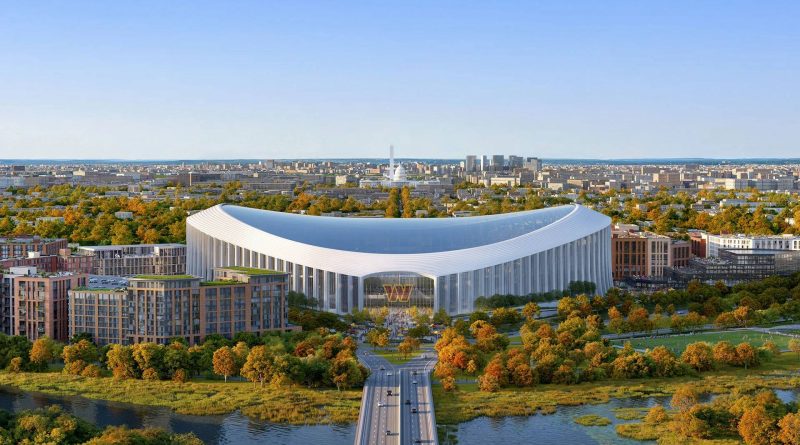
Commanders target 2030 opening for $3.8B stadium
Subscribe to our free newsletter today to keep up to date with the latest construction news.
The Washington Commanders have selected Clark Construction Group, Mortenson and Smoot Construction Co. of Washington, DC, to lead construction of the team’s planned $3.8 billion stadium at the former RFK Stadium site.
The companies will operate as the Clark | Mortenson | SmootDC joint venture on the 1.8 million-square-foot enclosed venue. The stadium is planned for about 65,000 seats and will anchor the wider redevelopment of the 180-acre RFK campus.
Enabling work began in June, with full construction expected to start in spring 2027. The stadium is scheduled to open for the Commanders’ 2030 season.
The appointment brings one of Washington’s largest planned construction projects closer to delivery. It also shifts attention from the politics and financing of the Commanders’ return to the harder question of how a project of this scale will be built within a wider urban redevelopment.
Stadium experience will matter as the schedule tightens
Each member of the joint venture brings experience in major sports and entertainment construction.
Clark has delivered high-profile projects across the Washington region, while Smoot has a long-standing local presence. Mortenson adds NFL experience from projects including U.S. Bank Stadium in Minneapolis and Allegiant Stadium in Las Vegas. The joint venture also has experience on Washington venues including Nationals Park and Capital One Arena.
That background matters because the Commanders are planning a large enclosed stadium with a fixed opening date.
The venue is expected to be climate controlled and designed for year-round use, including sports, concerts and other major events. That increases the range of structural, mechanical, electrical and technology systems that must be coordinated before handover.
A District project report published in June placed the main construction start in the first quarter of 2027 and completion in the second quarter of 2030, followed by the first event in the third quarter. At that stage, the stadium remained in design development.
That creates a defined but demanding delivery window. Design review, procurement, site work and construction will need to remain closely aligned if the 2030 opening is to hold.
Federal review is also part of that schedule. The National Capital Planning Commission has reviewed preliminary site and building plans, including the stadium’s relationship with the wider RFK campus and Washington’s urban setting.
Engineering News-Record reported Aug. 11 that the design was in the final stages of federal review, with further work requested on parts of the stadium entrances before a later Commission of Fine Arts vote.
The wider RFK redevelopment raises the delivery stakes
The stadium is only one part of the RFK redevelopment.
The District and Commanders have outlined a broader program that includes housing, hotels, restaurants, retail, parks, recreation facilities and supporting infrastructure across the 180-acre site. The Commanders have committed at least $2.7 billion toward the roofed stadium and related improvements.
Public spending is also planned for infrastructure and other supporting work. Earlier project plans included District funding for roads, utilities, parking and other site preparation.
That wider scope changes the delivery challenge. Stadium construction will need to progress alongside separate infrastructure and mixed-use projects, each with its own schedule, approvals and contractors.
District planning material has identified work across infrastructure, design, engineering, program management and construction. Local participation requirements will add another layer to procurement and delivery.
The economic scale is also significant. When the stadium agreement was announced, the District estimated that stadium construction alone could support about 14,000 jobs.
That figure is a projection rather than a guaranteed employment total, but it indicates the size of the workforce and supply chain that may be required as the project reaches peak construction.
The 2030 deadline will test more than the stadium build
The appointment of Clark, Mortenson and Smoot gives the Commanders an experienced construction team, but it also makes delivery easier to judge against the project’s ambitions.
The next few years will test how well the stadium design, infrastructure work, regulatory approvals and construction schedule can be coordinated. That matters because the venue is being delivered within a 180-acre redevelopment rather than as a stand-alone project.
The 2030 opening target adds pressure. Large enclosed stadiums carry complex structural, building services and technology requirements, while major event venues have limited flexibility once an opening season is set.
The construction team’s role therefore extends beyond keeping the stadium on time and on budget. Its ability to coordinate work across the site will influence whether the RFK redevelopment progresses as a connected program or as a series of projects competing for time, labor and access.
Until now, much of the debate around the Commanders’ return to Washington has centered on financing, planning and politics. With the lead builders selected and enabling work underway, attention is likely to turn increasingly to execution and whether the timetable can withstand the project’s complexity.
Source
Photo credit