Can the world’s tallest building deliver on Saudi Arabia’s ambitions?
Subscribe to our free newsletter today to keep up to date with the latest construction news.
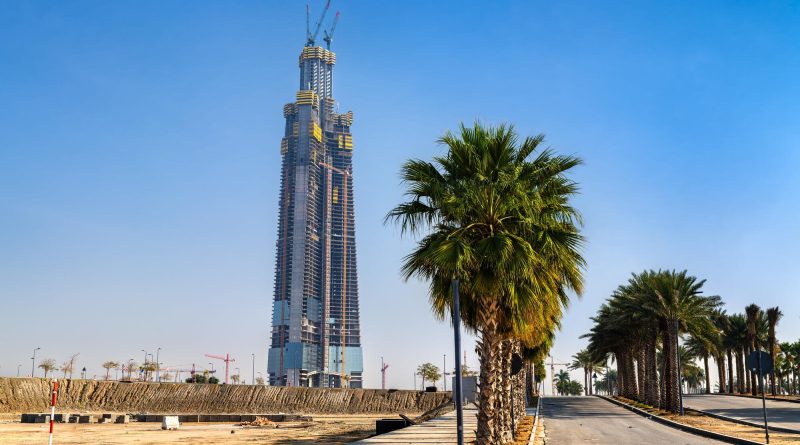
Construction of Jeddah Tower recently passed the 100-floor mark, bringing Saudi Arabia closer to completing what is expected to become the world’s tallest building. Once finished, the skyscraper is planned to exceed one kilometer in height, overtaking Dubai’s Burj Khalifa and establishing a new engineering benchmark.
The milestone attracted global attention, but it only tells part of the story.
Jeddah Tower was never conceived simply as a record-breaking structure. From its earliest plans, the development has been positioned as the centerpiece of a wider urban district intended to attract investment, tourism and international business. It also reflects Saudi Arabia’s broader ambition to diversify its economy through Vision 2030, using landmark projects to reshape both its cities and its global image.
The question is no longer whether the tower will become the tallest in the world. The more important question is whether it can deliver the long-term economic value its developers envision.
A landmark designed to anchor an entirely new district
Unlike many iconic skyscrapers, Jeddah Tower is not intended to stand alone.
It forms the focal point of Jeddah Economic City, a master-planned mixed-use development that combines residential neighborhoods, commercial offices, hospitality, retail and public spaces within a single urban district. The tower is designed to act as the project’s defining landmark while encouraging investment across the surrounding development.
This reflects a wider trend in global real estate. Signature skyscrapers increasingly serve as catalysts for regeneration rather than isolated architectural statements. Cities use them to attract businesses, visitors and residents while raising the profile of surrounding neighborhoods.
Whether that strategy succeeds depends less on architectural records than on sustained economic activity. Office occupancy, residential demand, hotel performance and infrastructure investment will ultimately determine whether Jeddah Economic City becomes a thriving destination rather than simply the home of an extraordinary building.
Vision 2030 gives the project its broader purpose
Jeddah Tower has become closely associated with Saudi Arabia’s Vision 2030, the government’s long-term strategy to reduce reliance on oil by expanding sectors such as tourism, logistics, technology and private investment.
The tower is one of several high-profile developments intended to support that transition, alongside projects that seek to attract international visitors, global businesses and foreign capital.
In that context, height is symbolic rather than an end in itself.
Throughout history, landmark buildings have often projected economic confidence as much as engineering capability. New York’s Empire State Building, Kuala Lumpur’s Petronas Towers and Dubai’s Burj Khalifa each became closely linked with broader narratives about national growth and international ambition.
Saudi Arabia appears to be pursuing a similar strategy. Jeddah Tower signals confidence in the country’s long-term economic plans while helping position Jeddah as a destination for commerce, tourism and investment.
The project also reflects growing competition among Gulf cities. While Dubai established itself through finance, tourism and iconic architecture, Saudi Arabia is investing heavily in infrastructure and urban development as it seeks to attract multinational companies and international talent.
Luxury real estate is central to the tower’s commercial model
Although its height dominates headlines, Jeddah Tower is fundamentally a mixed-use real estate project.
Plans include luxury residences, premium office space, a luxury hotel, retail facilities and observation areas. This combination mirrors a broader shift in high-end property development, where developers increasingly seek to create destinations that blend living, working and leisure within a single address.
Luxury residential property has become an important component of major urban developments worldwide. Premium homes associated with globally recognised landmarks often command higher values because of their location, amenities and international profile.
For Jeddah Tower, those residential and commercial elements are likely to be as important to its financial success as ticket sales to an observation deck. Long-term demand for premium office space, hospitality and high-end housing will help determine whether the project generates lasting economic returns.
Sustainability remains one of the project’s most closely watched claims
Modern skyscrapers are increasingly expected to demonstrate strong environmental performance alongside engineering excellence, and Jeddah Tower is no exception.
The building’s architects have said its aerodynamic form helps reduce wind loads while its high-performance exterior is intended to limit solar heat gain, reducing cooling demand in Jeddah’s hot climate. Efficient mechanical systems, daylight optimisation and water management have also featured prominently in the project’s published design objectives.
Those measures align with broader trends in sustainable high-rise construction, where improving operational efficiency has become a key design priority.
At the same time, megatall buildings continue to generate debate among architects, engineers and environmental specialists. Structures built primarily from concrete and steel require significant quantities of materials, resulting in substantial embodied carbon before they even open. Critics argue that this environmental cost must be weighed against any operational efficiencies achieved during the building’s lifetime.
That tension means sustainability cannot be assessed through design intentions alone. The tower’s long-term environmental performance will depend on how efficiently it operates, how intensively it is used and how successfully the wider district develops around it.
Its legacy will depend on what happens after construction ends
When Jeddah Tower eventually opens, it will almost certainly redefine the global skyline.
Whether it also transforms Jeddah’s economy is a far more significant question.
If the surrounding district attracts businesses, residents, visitors and sustained investment, the tower may become a case study in how landmark architecture can support wider urban development. If demand falls short of expectations, it risks becoming another example of an iconic building whose symbolic value exceeded its commercial impact.
The recent construction milestone demonstrates that one of the world’s most ambitious engineering projects is moving forward once again. Its lasting importance, however, will not be measured in meters or floor counts. It will be judged by whether it succeeds in advancing the economic, urban and strategic ambitions that inspired it in the first place.
Source