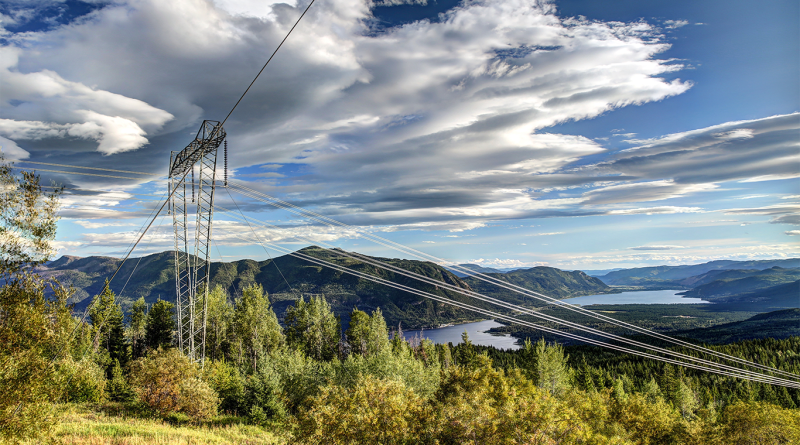
British Columbia starts work on a major $6B northern power corridor
Subscribe to our free newsletter today to keep up to date with the latest construction news.
Construction has started on one of British Columbia’s largest electricity infrastructure projects, a transmission expansion intended to solve a problem increasingly familiar to industrial economies: companies want more power than the existing grid can provide.
BC Hydro’s North Coast Transmission Line will add new 500-kilovolt infrastructure between Prince George and Terrace, an industrial corridor where proposed mines, LNG facilities, ports and other large projects are competing for access to electricity.
Phase 1 covers about 165 kilometers between the Williston Substation near Prince George and the Glenannan Substation near Fraser Lake. Phase 2 will continue for about 275 kilometers from Glenannan to the Skeena Substation near Terrace. BC Hydro is targeting fall 2030 for Phase 1 to enter service and mid-2032 for Phase 2.
The preliminary cost estimate for the first two phases is about $6 billion. The scale of the investment reflects a change in the role of transmission infrastructure. Power lines have traditionally been built to connect existing communities, generating assets or established industrial loads. In northern British Columbia, the grid is increasingly being treated as an economic development platform built partly in anticipation of future demand.
The existing 500-kilovolt transmission system between Prince George and Terrace has reached the point where projected electricity demand exceeds its available capacity. Adding new generation elsewhere in the province does little for an industrial customer if the network cannot carry that electricity to the site where it is needed.
For a mining company assessing a multibillion-dollar project, reliable power can influence operating costs and the feasibility of electrifying equipment. LNG developers face similarly large electricity requirements. Port expansions, processing operations and new critical-mineral projects add further pressure.
British Columbia’s response is to increase the amount of electricity that can reach the region before all of that prospective demand becomes operational.
The power line is also an industrial development project
Government projections illustrate the economic expectations attached to the North Coast Transmission Line.
British Columbia estimates that industrial projects supported by the expanded grid could create about 9700 direct full-time jobs, contribute nearly $10 billion per year to provincial GDP and generate roughly $950 million a year in revenue for provincial and municipal governments.
Those figures are forecasts rather than guaranteed outcomes. They depend on industrial projects reaching investment decisions, obtaining permits, securing financing and entering operation.
The figures still show why a transmission project has moved near the center of the province’s industrial policy.
A clear example is the proposed Ksi Lisims LNG project on Nisga’a Treaty Lands. BC Hydro signed a memorandum of understanding with the project in January outlining steps to provide as much as 600 megawatts of electricity.
For perspective, that is not a marginal addition to the grid. A single industrial customer seeking hundreds of megawatts can place substantial demands on regional transmission infrastructure.
Ksi Lisims LNG is only part of the prospective load. The province has also linked the transmission expansion to mining and critical-mineral development in northwestern British Columbia. Those industries can require large and consistent electricity supplies for extraction, crushing, grinding, processing, ventilation and other operations.
The result is a tighter connection between electrical infrastructure and industrial competitiveness.
For decades, companies selecting industrial sites have weighed factors such as access to roads, railways, ports, labor and raw materials. Grid capacity now belongs on the same list.
A site can possess strong mineral deposits or good access to export infrastructure yet remain commercially difficult if additional electricity cannot be delivered on a workable schedule.
That issue is becoming more pronounced as companies electrify processes previously powered directly by fossil fuels. Electrification can reduce on-site emissions, but it transfers more demand to the electricity system.
The federal and provincial governments have committed $3.9 billion toward phases 1 and 2 of the North Coast project through the Canada-British Columbia Co-operative Prosperity Agreement. The Canada Infrastructure Bank had earlier provided a $139.5 million loan to BC Hydro for engineering, route clearing, consultation and other pre-construction work.
Construction activity now includes clearing, access development, workforce accommodation, equipment areas and supporting infrastructure. BC Hydro expects Phase 1 construction to continue through the remainder of the decade, with major Phase 2 construction scheduled to begin in spring 2027.
At peak activity, the province forecasts about 1400 construction workers across the first two phases.
First Nations ownership could reshape who benefits from the grid
First Nations participating in the North Coast Transmission Line have been given an opportunity to acquire equity in the new infrastructure, with potential Indigenous ownership of up to 50 percent.
That creates a different economic model from one based only on consultation, compensation, short-term construction contracts or employment. Equity ownership can provide communities with a direct financial interest in infrastructure designed to operate for decades. The structure could pair construction and procurement opportunities with longer-term returns linked to ownership.
The federal Major Projects Office says several First Nations represented through the K’uul Power consortium have signed agreements that provide an option to acquire up to 50 percent equity in the project.
The details matter. An option to invest is not the same as completed ownership, and individual agreements, financing arrangements and participation decisions will determine how much equity First Nations eventually hold.
Major energy and resource projects often cross Indigenous territories, making the structure of Indigenous participation a commercial issue as well as a legal and political one. Equity arrangements have become one method of aligning long-term economic interests between infrastructure owners and affected communities.
Its significance will extend beyond the transmission line if the model proves workable. New mines, renewable power projects, pipelines, ports and other infrastructure across Canada increasingly face the same question: whether Indigenous communities participate only as stakeholders or hold an ownership interest in the assets being developed.
The North Coast Transmission Line should be viewed in the context of a much larger electricity challenge. Canada is asking its power systems to perform several jobs at once. Utilities must replace aging infrastructure, connect new generating capacity, serve population growth and supply industries seeking to electrify their operations.
At the same time, new sources of demand are appearing from data centers, artificial intelligence infrastructure, battery manufacturing and other electricity-intensive sectors.
British Columbia’s decision to proceed with the North Coast Transmission Line reflects a broader shift in how governments and utilities are thinking about industrial infrastructure. Electricity demand is no longer rising only from households and commercial users. Mining, LNG, processing and other large projects are placing new pressure on transmission systems, and the regions with available grid capacity may have an advantage in attracting investment.
For British Columbia, the $6 billion project is therefore as much about economic positioning as it is about power delivery. Expanding transmission between Prince George and Terrace could give future industrial projects greater certainty around one of their most important operating requirements, while creating new opportunities for Indigenous ownership, construction and long-term infrastructure participation.
The challenge will be matching that investment with real demand. Transmission projects require years of planning and construction, while industrial projects can change course quickly because of commodity prices, financing conditions, permitting or global demand.
That is the calculation behind the North Coast project. British Columbia is choosing to create capacity before every prospective customer is ready to use it. If enough of those projects move forward, the new corridor could become one of the foundations of the province’s next phase of industrial growth.
Source:
CBC News