
Brava’s Thomas Knuckey explains durability, transparency, and lifecycle thinking in sustainable roofing decisions
To begin, what has your career journey looked like, and what led you into product management within the roofing industry?
My career has been built at the intersection of customer insight, product development, and commercial strategy. In product management, the job is to translate market needs into clear priorities and a deliverable plan, then align cross-functional teams to execute.
Before roofing, I worked in commercial product management in categories such as office and contract furniture, which sharpened how I prioritize customer needs, manage constraints, and bring new products to market through a disciplined process. Product management is a strong fit for me because it connects the voice of the customer, operational capabilities, and business strategy in one role. Those skills are directly transferred to roofing, where the industry is continually innovating to solve the increasingly demanding weather challenges and changing code requirements. At Brava, I lead our product team and balance the needs of architects, contractors, and building owners to ensure we deliver products that fit the market, can be specified easily, and provide long-term confidence with proven performance.
Many products promote recycled content as a sustainability benefit. Why do you believe recycled content alone doesn’t tell the full story?
Recycled content is important, but it is only one part of a much larger sustainability equation. The better question is: what is the full lifecycle impact? If a product fails prematurely, requires frequent maintenance, or gets replaced sooner than expected, the upstream recycled content does not offset what is happening downstream. In roofing, sustainability must be viewed across the full life of the roof. That includes how a material is sourced, how it is manufactured, how long it performs, and if it can be recycled at the end of its life. All these factors carry an environmental cost that a single recycled content number cannot capture. Third-party certifications help because they give architects and developers documentation they can review and use. Recycled content is a meaningful aspect, but it doesn’t answer the more important full impact question.
Roofing is one of the biggest investments in a building envelope. How does durability change the sustainability equation over a roof’s lifetime?
Durability changes the conversation because sustainability is not just about what a product is made from — it is also about how long it performs. If the roof has to be replaced prematurely, that creates another full cycle: material production, transportation, disposal, and installation. A product that performs longer and avoids that cycle has an additional sustainability argument that recycled content alone cannot make.
That is why performance testing matters. Architects and developers should assess how a product performs against the region’s actual risks: wind, fire, hail, UV exposure, freeze-thaw conditions, and applicable code requirements. Durability also heavily relies on the installation of products. Even a strong product can underperform if it is not installed correctly, and third-party certifications aid in clearly laying out those requirements.
For Brava, that connection between verified performance and long-term value is documented through third-party code evaluations covering severe weather resistance like hail, wind, and fire classifications, all supported by a standard 50-year limited lifetime warranty that proves how durability adds to the sustainability story.
How should architects and developers evaluate the true sustainability of a roofing product beyond the marketing claims?
Start with documentation. A sustainability claim should be specific, third-party verified where possible, and connected to how the product will perform on the project. Broad statements about environmental commitment are not the same as certified evidence.
I think about this across four areas: material transparency (what the product is made of and how that is verified), manufacturing accountability (waste diversion practices, facility-level certifications, and sourcing documentation), performance evidence (independent evaluation reports from recognized agencies covering fire, wind, hail, and regional code compliance), and installation integrity, because a product’s real-world performance relies on the craftsmanship and installation of the crews installing.
LEED-related documentation fits into this framework in a useful way: it gives project teams a structured basis for evaluating sourcing and manufacturing practices. A single product does not guarantee LEED credits, but manufacturers with the proper certifications help clearly identify how a product can contribute to project points and carry real financial, regulatory, and market benefits to the project teams.
What are the biggest misconceptions you see in the market around “green” roofing materials today?
One of the most persistent misconceptions I encounter is that designing for sustainability requires a performance tradeoff, or that incorporating recycled content or prioritizing environmental responsibility means accepting a less capable product. In reality, the opposite can be true when engineering is done well. Recycled polymers, for example, can be formulated to deliver the same structural integrity, impact resistance, and weather durability as newly manufactured materials, while simultaneously reducing the demand for raw resource extraction, lowering manufacturing energy consumption, and diverting material from the waste stream. Material science continues to advance, and today, the most thoughtfully engineered sustainable products are not compromising on performance. They are using sustainability as a design discipline that pushes product quality forward. The goal is not to choose between a product that performs and one that is responsible. It should be both.
How is innovation in material composition helping synthetic roofing products outperform traditional options?
Material innovation allows synthetic roofing products to address specific challenges that traditional options can present in certain applications.
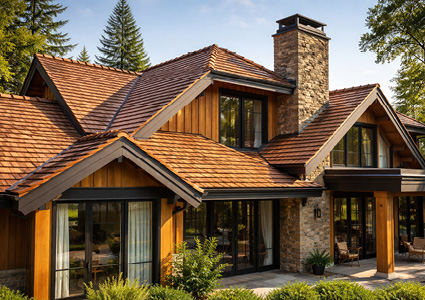
Engineered materials give manufacturers the opportunity to control performance, resistance, colors, and weights of synthetic products. A product that performs well in one region faces entirely different demands in another, from fire exposure in wildland-urban interface zones or hail in high-impact corridors, to wind in coastal environments, and freeze-thaw performance in northern climates. Synthetic innovation continually drives towards addressing the most demanding regional requirements while at the same time providing the realistic aesthetic of traditional materials that architects, designers, and building owners want.
What role does manufacturing transparency play in helping the A&D community make better material choices?
Manufacturing transparency is becoming an expectation for the A&D community. Architects and project teams working on sustainability-focused, institutional, or commercial projects need documentation they can use in project submissions to achieve LEED support and meet environmental impact requirements. That means third-party certifications that are specific, auditable, and publicly accessible. At Brava, our GreenCircle recycled content certifications document recycled content across Cedar Shake, Slate, and Spanish Barrel product lines. Our GreenCircle waste diversion certification independently verifies 95 percent waste diversion from landfill at our Washington, Iowa, manufacturing facility. Those certifications also provide documentation relevant to LEED criteria, which can matter to project teams evaluating whether a product supports broader project sustainability goals.
How can smarter product engineering help reduce waste during production, installation, and replacement?
Smarter product engineering can reduce waste at several points across the lifecycle. In design, it means optimizing material selection to meet performance requirements efficiently. In production, it means improving material utilization, reprocessing scrap, reducing defects, and designing lean processes that create less waste from the start. During installation, it means designing products that are easier to handle, more consistent in the field, and that reduce the breaks, cuts, errors, and rework that generate job-site waste.
At the end of the day, the goal is to develop products the market wants that are efficient to manufacture, practical to install, and durable in service. Reducing waste at every stage of the lifecycle optimizes material utilization and reduces the environmental impact.
When specifying roofing for long-term performance, what key metrics should architects and developers focus on most?
The most important metrics are connected to the severe weather that the structure needs to endure. Fire classification, wind resistance, hail and impact resistance, and UV stability all matter, but the performance level required for each of those factors will heavily depend on local codes tailored to expected weather conditions.
From there, I would look closely at how those performance claims are verified. Independent code evaluation reports from recognized third-party agencies carry the most weight. Brava’s products are evaluated independently and have a published code evaluation report covering weather resistance, wind resistance, roof fire classification, and hail-impact resistance. State approvals, such as the Texas Department of Insurance, Florida Product Approval, and Miami-Dade NOAs, add regional specificity that matters in extreme weather markets.
Looking ahead, how do you see sustainability expectations reshaping the roofing industry over the next five years?
In my opinion, sustainability expectations will continue towards specific and documented proof that answers questions like: What is the recycled content, and how is it verified? How much waste is generated in manufacturing, and by whom? How long is the product expected to perform in this region? What happens when it is replaced?
One industry trend worth watching is the growing expectation for environmental product declarations (EPD) and lifecycle assessments across the roofing category. EPDs give project teams a standardized framework for comparing the environmental footprint of products from raw material through end of life. That level of transparency requirement is growing and will continue to be more impactful in roofing.
I also think industry organizations like PEPA can play a meaningful role in helping the synthetic roofing category develop clearer standards and more consistent transparency practices. Stronger, category-wide standards benefit everyone in the market.
The companies that earn long-term trust will be the ones that can combine documented performance, verified sustainability, and practical job-level support for the project teams specifying their products.
Thomas Knuckey
www.bravarooftile.com
Thomas Knuckey is Director of Product Management at Brava Roof Tile. Brava manufactures premium-quality synthetic roofing that combines the authentic look of shake, slate and barrel roofing with unmatched performance. As a leading alternative to traditional roofing material, its composite roofing products lasts longer, are far more durable than traditional cedar shake, slate and Spanish barrel tiles, and are much more aesthetically and architecturally pleasing than asphalt shingles and concrete tiles.