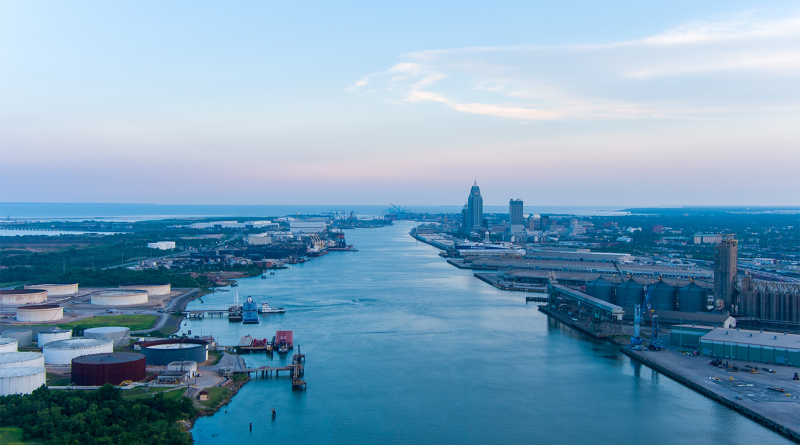
Alabama starts work on $3.2 billion Mobile River Bridge
Subscribe to our free newsletter today to keep up to date with the latest construction news.
Alabama has broken ground on the $3.2 billion first phase of the Mobile River Bridge and Bayway project, moving one of the state’s most ambitious transportation plans from decades of preparation into active construction.
The project is intended to increase Interstate 10 capacity across the Mobile River and Mobile Bay, improve access to the Port of Mobile and address a long-standing congestion problem affecting both passenger traffic and commercial freight. Phase One includes a new six-lane cable-stayed bridge over the Mobile River, modifications to the existing Bayway to provide three travel lanes in each direction and a series of interchange and traffic-flow improvements across Mobile and Baldwin counties.
Construction is expected to take about five years, which would place the opening of the new bridge and associated Phase One improvements around late 2031. The schedule represents a significant transition for a project that has spent years moving through planning, environmental review, design, engineering and financing.
The scale of the investment makes the scheme notable for the US construction sector, but its importance extends beyond the bridge itself. The project sits on I-10, one of the principal east-west highway corridors across the southern United States, and is designed to reduce a transportation constraint near one of the Gulf Coast’s major maritime gateways.
A $3.2 billion project targets a long-standing I-10 constraint
Traffic crossing the Mobile River currently depends heavily on the George Wallace Tunnel and the existing Bayway, creating a corridor where capacity limitations can affect both local travel and long-distance freight movement. The problem is more complicated for certain commercial vehicles because trucks carrying hazardous materials are prohibited from using the Wallace Tunnel.
Those vehicles must leave the Interstate system and divert onto local roads before returning to I-10, adding complexity to journeys through the Mobile area. The new Mobile River Bridge is expected to provide an Interstate crossing for that traffic, allowing affected freight operators to remain on the highway network instead of using local diversion routes.
For trucking companies, manufacturers and logistics operators, the value of that change is not limited to the number of miles saved on an individual trip. More predictable routing can influence fleet planning, driver hours, delivery schedules and the ability to coordinate arrivals with ports, warehouses and manufacturing facilities.
The US Department of Transportation estimates that the wider I-10 improvements could reduce travel times by as much as 30 minutes. The project is also intended to improve access to the Port of Mobile, linking the highway improvements to a wider logistics network that serves maritime, industrial and distribution activity along the Gulf Coast.
That connection is particularly relevant as ports compete not only on terminal capacity but on the efficiency of the road and rail networks that serve them. Investments in terminals, warehouses and industrial sites can lose some of their commercial value when inland connections are unreliable or congested.
For Alabama, the Mobile River Bridge therefore represents more than a response to daily traffic delays. The project is intended to improve the performance of a corridor that connects Interstate freight traffic, local industries, port operations and regional supply chains.
The current design also reflects a shift in how the broader program will be delivered. Instead of replacing the entire Bayway at the same time as the new bridge, Alabama divided the scheme into phases after rising construction costs, engineering demands and other financial pressures made the original approach more difficult to fund.
Under Phase One, the existing Bayway will be restriped to provide six lanes of traffic, while roughly one mile will be reconstructed to connect it with the new bridge. A replacement Bayway remains planned for Phase Two, which is expected to move forward when additional funding becomes available.
Federal financing turns a long-planned bridge into a construction program
The Mobile River Bridge reached the construction stage only after Alabama assembled a financing structure capable of supporting a project of unusual scale for the state.
The Alabama Toll Road, Bridge and Tunnel Authority secured a Transportation Infrastructure Finance and Innovation Act loan of up to $2.52 billion through the US Department of Transportation’s Build America Bureau. Alabama also completed bond sales to support the $3.2 billion Phase One construction cost.
Federal participation includes a $550 million Bridge Investment Program grant and a $125 million Infrastructure for Rebuilding America grant, alongside state investment and future toll revenue.
The structure offers a useful example of how large infrastructure programs are being financed in an environment of rising labor, material and financing costs. Project sponsors increasingly face difficult decisions when original budgets no longer support the full scope of planned work, forcing them to choose between larger funding commitments, reduced scope, delayed construction or staged delivery.
Alabama opted for a phased approach that allows the new Mobile River crossing and related improvements to proceed without waiting until the complete Bayway replacement can be financed. Future toll revenue is expected to contribute to the funding of the second phase.
Tolling has remained one of the project’s most sensitive issues, particularly for regular commuters and local businesses that depend on the corridor. No tolls will be collected during construction, and charges are scheduled to begin only after the new bridge and Phase One improvements are open to traffic.
Under the current plan, passenger vehicles using an ALGO Pass would pay $3 per trip, while a $60 monthly option is planned for frequent users. Existing alternatives, including the Wallace Tunnel, Bankhead Tunnel, Africatown Bridge and Causeway, are expected to remain toll-free.
The financing model brings together federal credit, grant funding, state participation, bond markets and future user revenue. For infrastructure executives, the project provides a practical example of how several funding mechanisms can be combined to move a large and politically complex transportation program from planning into construction.
Freight capacity strengthens the commercial case for the project
The formal groundbreaking on Oct. 2 followed nearly three decades of planning, environmental review, design, engineering and financing work. The Kiewit Massman Traylor design-build team began mobilizing after receiving a notice to proceed in late September, marking the start of the project’s most visible stage.
The five-year construction program will test whether Alabama’s phased strategy can deliver additional capacity and a new river crossing without waiting for completion of the longer-term Bayway replacement.
For commercial users, the project’s performance will eventually be judged less by the scale of the engineering than by its effect on day-to-day operations. Lower average travel times will matter, but logistics operators are often equally concerned with reliability because unpredictable congestion can make it difficult to schedule drivers, deliveries and terminal appointments.
A corridor that performs more consistently can support tighter fleet planning and improve coordination between trucking companies, warehouses, industrial facilities and port terminals. The ability of hazardous-material traffic to remain on the Interstate system could provide another measurable operational advantage for carriers that currently depend on diversion routes through the Mobile area.
Alabama is pursuing the Mobile River project while continuing to fund smaller road improvements across the state. The final fiscal 2026 round of the Annual Grant Program awarded $3.8 million to 13 local road projects, bringing total annual awards above $15 million. Cities and counties contributed more than $1.3 million in matching funds.
The difference in scale between the two programs illustrates the range of investment required to support a functioning transportation network. A multibillion-dollar bridge can remove a strategic bottleneck, but resurfacing, widening and rehabilitation projects determine the condition of the roads that connect businesses, communities and industrial sites to major corridors.
The Mobile River Bridge is now entering the stage in which planning, engineering, financing and political commitments must be converted into construction progress. By around 2031, Alabama expects to have a new Interstate crossing over the Mobile River and significantly greater capacity through one of the Gulf Coast’s most important highway corridors.
Source:
Roads & Bridges