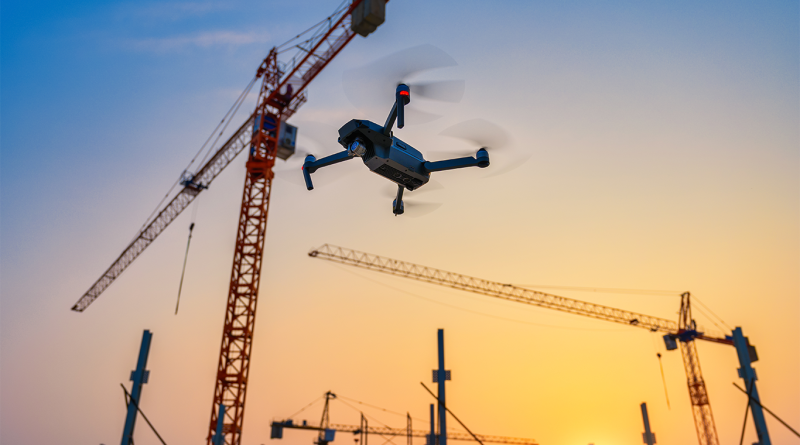
8 practical uses for drones on today’s construction sites
The use of construction drones has shifted from niche experimentation to mainstream adoption across commercial and infrastructure projects. Contractors are increasingly investing in aerial technology to improve visibility, reduce delays and strengthen site safety. According to industry estimates, the global market for drones in construction could exceed $19 billion by 2032 as adoption accelerates across surveying, inspections and project management.
For project managers facing rising costs, labour shortages and tighter delivery schedules, drones are becoming an essential part of the broader construction technology ecosystem. Equipped with high resolution cameras, thermal sensors and LiDAR systems, drones can capture and analyse job site data in a fraction of the time required by traditional methods.
Here are eight ways drones are being used on modern construction sites.
1. Site surveying and mapping
One of the most common applications for construction drones is aerial surveying. Traditional land surveys can take days or even weeks depending on the scale of a project. Drones can complete the same work within hours while capturing far more visual data.
Using photogrammetry and LiDAR technology, drones generate detailed topographical maps, elevation models and orthomosaic imagery. These outputs allow contractors to assess terrain conditions before excavation begins and improve planning accuracy for infrastructure placement.
Industry data suggests drone surveys can reduce surveying time dramatically. Some reports indicate a 12 acre property that would traditionally require around 100 labour hours can be mapped in just two hours using drone technology.
The speed advantage is particularly valuable on large infrastructure projects where changing site conditions require constant updates. Drone generated mapping also integrates directly with BIM platforms and civil engineering software, creating a more connected digital workflow.
2. Progress monitoring and reporting
Construction firms are increasingly using drones to document progress throughout the lifecycle of a project. Scheduled drone flights provide project managers with accurate visual records that can be compared week by week.
This creates a reliable method for tracking milestones, validating subcontractor performance and identifying delays before they escalate into larger problems. High resolution aerial footage also improves communication between field teams, clients and investors.
Remote stakeholders can review site conditions without travelling to the project location, which reduces delays in approvals and reporting processes. Many contractors now include drone footage in client updates and investor presentations because it provides a clear and measurable view of project development.
Experts across the construction technology sector expect remote monitoring to become one of the most important operational trends over the next few years as data driven project delivery becomes standard practice.
3. Safety inspections and hazard detection
Safety remains one of the largest priorities across construction sites, particularly on complex commercial and infrastructure developments. Drones are increasingly being used to inspect hazardous or difficult to access areas without exposing workers to unnecessary risk.
Rather than sending crews onto unstable scaffolding, rooftops or confined spaces, contractors can deploy drones equipped with cameras and thermal imaging systems. These inspections can identify structural weaknesses, overheating equipment and unsafe working conditions in real time.
Thermal sensors are especially useful for detecting electrical faults, water intrusion and heat loss in partially completed buildings. This allows teams to resolve issues earlier before they develop into larger operational failures.
Drone based inspections also support compliance reporting and insurance documentation. Because all footage is digitally recorded, contractors can maintain detailed records of site conditions throughout the project lifecycle.
As construction companies continue to adopt automation tools, drones are becoming a central component of smarter and safer site management strategies.
4. Earthwork and stockpile measurement
Managing materials efficiently is critical for maintaining profitability on large construction projects. Drones are now widely used to calculate stockpile volumes, track earthmoving progress and monitor excavation work with high levels of accuracy.
Using aerial scans and 3D modelling software, contractors can quickly measure gravel piles, soil movement and aggregate quantities. This eliminates the need for manual calculations that are often time consuming and prone to error.
Accurate stockpile measurement helps project managers improve procurement planning and reduce material waste. It also enables contractors to verify subcontractor billing against actual completed work.
High end drone systems equipped with RTK positioning and LiDAR sensors can deliver survey grade accuracy suitable for civil engineering and infrastructure applications. Several enterprise drone platforms are now specifically designed for volume calculations and terrain modelling.
For contractors managing large scale earthworks, these capabilities can produce significant cost savings while improving project visibility.
5. Equipment tracking and asset management
Construction sites often involve hundreds of moving assets including vehicles, generators, containers and heavy equipment. Keeping track of those resources can become difficult on large or fast moving projects.
Drones provide project teams with an efficient way to monitor equipment usage and site logistics. Regular aerial scans allow managers to locate machinery quickly, identify underused assets and improve operational coordination.
Some contractors are integrating drone data into broader digital construction management systems, enabling near real time visibility across multiple job sites. This supports better scheduling and reduces costly downtime caused by misplaced or unavailable equipment.
Drone surveillance can also help deter theft, which remains a major financial issue for many contractors. Aerial monitoring increases visibility across large perimeters and provides recorded evidence in the event of security incidents.
As construction sites become more digitised, drones are increasingly functioning as mobile data collection platforms that support broader operational intelligence.
6. Marketing and client communication
Construction companies are also using drones as a communication and marketing tool. Aerial footage creates compelling visual content that can be used across websites, investor presentations and social media channels.
Developers frequently use drone videos to showcase project milestones to investors and stakeholders. Commercial contractors also use aerial imagery to demonstrate capabilities when bidding for future work.
Drone footage provides clients with a level of transparency that traditional site photography cannot match. It allows them to understand site scale, progress and complexity more effectively.
This visual documentation has become especially valuable for remote investors and international stakeholders who cannot regularly visit construction sites in person.
As competition increases across the construction industry, firms that adopt visual technologies are often better positioned to demonstrate professionalism, transparency and technical capability.
7. Environmental monitoring and compliance
Environmental compliance requirements are becoming more demanding across construction and infrastructure projects. Drones are increasingly being used to monitor environmental impact and support regulatory reporting.
Construction drones can assess erosion, vegetation changes, drainage systems and sediment movement around active job sites. This helps contractors identify environmental risks earlier and avoid potential penalties or project delays.
On infrastructure projects, drones are also used to inspect nearby waterways, wetlands and protected areas without disrupting the environment itself. The ability to gather frequent aerial data improves the accuracy of environmental assessments and reporting procedures.
Some firms are now combining drone imagery with AI powered analytics to monitor environmental performance continuously throughout a project lifecycle.
As sustainability expectations continue to rise, drone technology is likely to play a larger role in helping contractors meet environmental standards while improving operational efficiency.
8. Digital twins and BIM integration
Perhaps the most advanced use of drones on construction sites is their integration with BIM and digital twin technologies. Drones can continuously capture site conditions and compare them against digital construction models in near real time.
This allows project teams to identify discrepancies between planned designs and actual site progress earlier in the process. Detecting these issues quickly can reduce costly rework and schedule overruns.
AI driven software platforms are increasingly capable of analysing drone data automatically and generating predictive insights around productivity, risk and sequencing. Industry experts believe this integration between drones, BIM and automation will define the next phase of construction technology adoption.
For contractors operating on thin margins, the ability to improve decision making through live site intelligence could become a major competitive advantage over the coming decade.
Construction sites are rapidly evolving into connected digital environments where aerial data plays a central operational role. From surveying and safety inspections to asset management and BIM integration, construction drones are delivering measurable improvements in efficiency, visibility and risk management.
As the construction industry continues to adopt smarter workflows, drones are no longer viewed as experimental technology. They are becoming an increasingly essential tool for contractors seeking to reduce costs, improve project delivery and modernise site operations.